
- Details
- Written by: ofurpaur
- Category: Site Content
- Hits: 38372
Out of a total of 4 million inhabitants of the Arctic, approximately 500,000 belong to indigenous peoples. Indigenous peoples' organizations have been granted Permanent Participants status in the Arctic Council. The Permanent Participants have full consultation rights in connection with the Council's negotiations and decisions. The Permanent Participants represent a unique feature of the Arctic Council, and they make valuable contributions to its activities in all areas. The following organizations are Permanent Participants of the Arctic Council:
{slider title="Arctic Athabaskan Council (AAC)" open="false"}
Arctic Athabaskan Council (AAC)
Territory: Alaska (United States), Yukon and Northwest Territories in Canada
Indigenous Peoples: Athabaskan
Indigenous Population: 45,000
Languages: 23
The AAC was established to defend the rights and further the interests internationally of American and Canadian Athabaskan members. The AAC also seeks to foster a greater understanding of the shared heritage of Athabaskan peoples of Arctic North America.
About the Athabaskan Peoples
The Athabaskan peoples have traditionally occupied a vast geographic area of approximately 3 million square kilometers. This region has been continuously occupied by Athabaskan peoples for at least 10,000 years. The ancestors of contemporary Athabaskan peoples were semi-nomadic hunters. The staples of Athabaskan life are caribou, moose, beaver, rabbits and fish. Collectively, the Arctic Athabaskan peoples share 23 distinct languages.
Peoples of Arctic Athabaskan descent represent approximately two percent of the resident population of Alaska (12,000), compared with about one-third of the Yukon Territory (10,000), the Northwest Territories and provincial norths (20,000) in Canada. Athabaskan peoples are a relatively young and growing population compared with non-Aboriginal Arctic resident groups.
Arctic Athabaskan Council in the Arctic Council
The AAC collaborates with Arctic States, Working Groups and other Permanent Participants regarding circumpolar relations with regular contributions to Chairmanship work plans. The AAC has particular interest in balancing environmental protection with economic sustainability.
Arctic Athabaskan Council Official website
Source: Arctic Council
{slider title="Aleut International Association (AIA)"}
Aleut International Association (AIA)
Territory: Alaska (United States), Russian Federation, Pribilof Islands (United States) and Commander Islands (Russian Federation)
Indigenous Peoples: Russian and American Aleut (Unangan)
Indigenous Population: Approximately 15,000 Aleuts in the United States and 350 Aleuts in the Russian Federation
Languages: English, Russian, Unangam Tunuu (Eastern Dialect of the Aleut Language), Niigugim Tunuu (Atkan Dialect of the Aleut Language)
About Aleut International Association
The Aleut International Association (AIA) is a not-for-profit corporation that represents the Indigenous peoples of Aleut descent in the United States and the Russian Federation. It was created by the Aleutian Pribilof Islands Association (APIA) and the Association of the Indigenous peoples of the North of the Aleut District of the Kamchatka Region of the Russian Federation (ANSARKO). AIA is governed by a Board of Directors comprised of four Alaskan and four Russian Aleuts under the leadership of a president.
AIA was formed to address environmental and cultural concerns of the extended Aleut family whose wellbeing has been connected to the rich resources of the Bering Sea for millennia. Its mission is to promote continuity of culture and protect the resources needed to sustain it. The need to understand global processes, such as trans-boundary contaminants transport, the impacts of climate change and the effects of commercial fisheries on the ecosystem of the Bering Sea, to name a few, was an impetus in joining in the work of international fora where AIA is actively pursuing collaboration with governments, scientists and other organizations to improve the wellbeing of the Aleut peoples and their environment.
In addition to its status as a Permanent Participant of the Arctic Council, AIA was granted Special Consultative Status by the Economic and Social Council of the United Nations in 2004. AIA is an accredited Non-Governmental Organization (NGO) with the United Nations Framework Convention on Climate Change (UNFCCC) and the Global Environment Facility (GEF).
About the Aleutian Peoples
The Unangan (Aleut) people have traditionally lived in the Aleutian Islands region of southwestern Alaska and the Commander Islands in the Russian Federation for nearly 10,000 years. Russian and American Aleuts are separated by distances, borders and the International Date Line, but united by the great Bering Sea and the North Pacific and the cultural practices that have helped the Aleut people to survive in the Aleutians.
Aleut International Association in the Arctic Council
The AIA was admitted as a permanent participant of the Arctic Council in 1998. As part of the Arctic Council framework, the AIA collaborates with Arctic States, Working Groups and other Permanent Participants with regular contributions to Chairmanship work plans. AIA has a particular interest in the ocean, and the environmental and social changes occurring in the region.
Aleut International Association Official website
Source: Arctic Council
{slider title="Gwich'in Council International (GCI)"}
Gwich'in Council International (GCI)
Territory: Alaska (United States), Yukon and Northwest Territories in Canada
Indigenous Peoples: Gwich’in
Indigenous Population: 9,000
Languages: Gwich’in (Dinju Zhuh Kʼyuu), one of 47 Athabascan languages
About the Gwich’in Council International
The Gwich’in Council International (GCI) is a non-profit organization that represents 9,000 Gwich’in in Alaska, United States and the Yukon and Northwest Territories in Canada.
GCI’s mission is to amplify the voice of the Gwich’in Nation on issues of sustainable development and the environment in international fora, predominantly the Arctic Council. GCI’s membership consists of two representative bodies in Canada and one in the United States: Gwich’in Tribal Council (GTC), who represents the beneficiaries of the Gwich’in Land Claims Settlement Act in Canada’s Northwest Territories; the Vuntut Gwich’in First Nation (VGFN), which is a self-governing First Nation in Old Crow, Yukon; and the Council of Athabascan Tribal Governments (CATG), for the eight Gwich’in communities in Alaska – Fort Yukon, Venetie, Arctic Village, Chalkyitsik, Birch Creek, Circle, Canyon Village and Beaver. GCI is governed by a volunteer Board of Directors, composed of four members from Canada and four from Alaska. Canada and Alaska each appoint a co-chair from its members.
About the Gwich’in Peoples
The Gwich’in people are one of the most northern Indigenous peoples in North America, living in the northwestern limits of the boreal forest. The Gwich’in are part of a larger family of Indigenous people known as Athabaskans, although their language and culture are distinct. The Gwich’in language, consisting of different dialects, is one of 47 Athabascan languages and is considered a severely endangered language today.
The Gwich'in life and culture has traditionally been based on the Porcupine Caribou herd, the people's main source of food, tools and clothing. The Gwich'in practiced a nomadic lifestyle until the 1870's, when fur traders came into the area to establish trading posts that later became settlements. Hunting, fishing and trapping remain important both culturally and economically, with caribou, moose and whitefish being staples of the Gwich’in diet.
Gwich’in Council International in the Arctic Council
GCI collaborates with Arctic States, Working Groups and other Permanent Participants regarding circumpolar relations with regular contributions to Chairmanship work plans. The GCI has particular interest in the environment and sustainable development to support resilient and healthy communities, and actively participates in the SDWG, CAFF, and EPPR Working Groups.
Gwich´in Council International Official website
Source: Arctic Council
{slider title="Inuit Circumpolar Council (ICC)"}
Inuit Circumpolar Council (ICC)
Territory: Alaska, Canada, Greenland and Chukotka
Indigenous Peoples: Inuit
Indigenous Population: 180,000
Languages: Numerous dialects of the Inuit language, English, Danish, Russian
About Inuit Circumpolar Council
To thrive in their circumpolar homeland, Inuit realized they must speak with a united voice on issues of common concern and combine their energies and talents towards protecting and promoting their way of life. ICC’s principle goals are to:
- Strengthen unity among Inuit of the Arctic region
- Promote Inuit rights and interests on an international level
- Develop and encourage long-term policies that safeguard the Arctic environment
- Seek full and active partnership in the political, economic and social development of the Arctic region
ICC has held Consultative Status II at the United Nations Economic and Social Council since 1983 and is active within the United Nations and its various subsidiary bodies. ICC consults regularly with the United Nations on a broad range of issues concerning the Arctic and Indigenous human rights.
About Inuit
Historically, Inuit were hunter/gatherers living a nomadic life in the Arctic following the game and the seasons. Inuit now live in widely dispersed communities throughout a vast area of the Arctic in North America, Greenland and the Russian Federation. Today, Inuit are an integral part of modern society, actively engaged within the global community.
Inuit Circumpolar Council in the Arctic Council
ICC was actively involved in the Arctic Environmental Protection Strategy, which later became the Arctic Council in 1996. ICC is one of the original Permanent Participants under the Arctic Council structure. ICC focuses great effort within the Arctic Council and is active in its various Working Groups, Task Forces and individual projects. ICC also participates in the Senior Arctic Officials meetings and Ministerial meetings. ICC considers the Arctic Council to be the premier international forum dealing with Arctic policy issues today.
Inuit Circumpolar Council Official website
Source: Arctic Council
{slider title="Russian Arctic Indigenous Peoples of the North (RAIPON)"}
Russian Arctic Indigenous Peoples of the North (RAIPON)
Territory: The Russian Federation
Indigenous Peoples: 40 Indigenous Peoples that live in the Russian Federation
Indigenous Population: 250,000
RAIPON's goal is to protect Indigenous Peoples’ human rights, defend their legal interests, assist in solving environmental, social, economic, cultural and educational issues and to promote their right to self-governance. RAIPON works with the State Duma and the Government of the Russian Federation regarding legislation related to Indigenous Peoples’ issues. In addition to its status as a Permanent Participant in the Arctic Council, RAIPON participates in international structures such as the United Nations Economic and Social Council with a special consultative status and the Governing Council, and the Global Ministerial Environment Forum of the United Nations Environment Program as an observer.
About the Russian Indigenous Peoples Represented in RAIPON
RAIPON represents 40 Indigenous peoples totaling over 250,000 people. The peoples represented in RAIPON live in 60 percent of the whole Russian Federation territory, including the North, Siberia and the Far East.
RAIPON's Indigenous community includes distinctive cultures with a variety of native languages and varied economic activities that are largely based on natural resources.
RAIPON in the Arctic Council
RAIPON collaborates with Arctic States, Working Groups and other Permanent Participants regarding circumpolar relations with regular contributions to Chairmanship work plans. RAIPON has particular interest in social and economic issues, environmental protection, cultural development and education.
Source: Arctic Council
{slider title="Saami Council (SC)"}
Saami Council (SC)
Territory: Finland, the Russian Federation, Norway and Sweden
Indigenous Peoples: Sámi
Indigenous Population: Estimated over 100,000
Languages: Nine
The Saami Council’s core missions are to:
- Promote Sámi rights and interests in the four countries where Sámi are living
- Consolidate the feeling of affinity among the Sámi people
- Attain recognition for the Sámi as a nation
- Maintain the economic, social and cultural rights of the Sámi in the legislation of the four states
About the Sámi People
The Sámi people live in Sápmi, an area that stretches across the northern parts of Finland, the Russian Federation, Norway and Sweden. There are no available statistics on how many Sámi there are, but over 100,000 is the estimate that is used most often. The majority of the Sámi population lives in Norway. There are nine total Sámi languages spoken today.
The Sámi people traditionally made their living from reindeer herding, fishing, livestock farming and hunting. Since 1989, the Sámi in Norway have had their own elected assembly – the Sámediggi – which acts as a consultative body for the Norwegian government authorities.
Saami Council in the Arctic Council
The Saami Council collaborates with Arctic States, Working Groups and other Permanent Participants regarding circumpolar relations with regular contributions to Chairmanship work plans. The Saami Council has particular interest in environmental protection and sustainable development in the Arctic.
Saami Council official website
{/sliders}
Source: Arctic Council
- Details
- Written by: ofurpaur
- Category: Site Content
- Hits: 65235
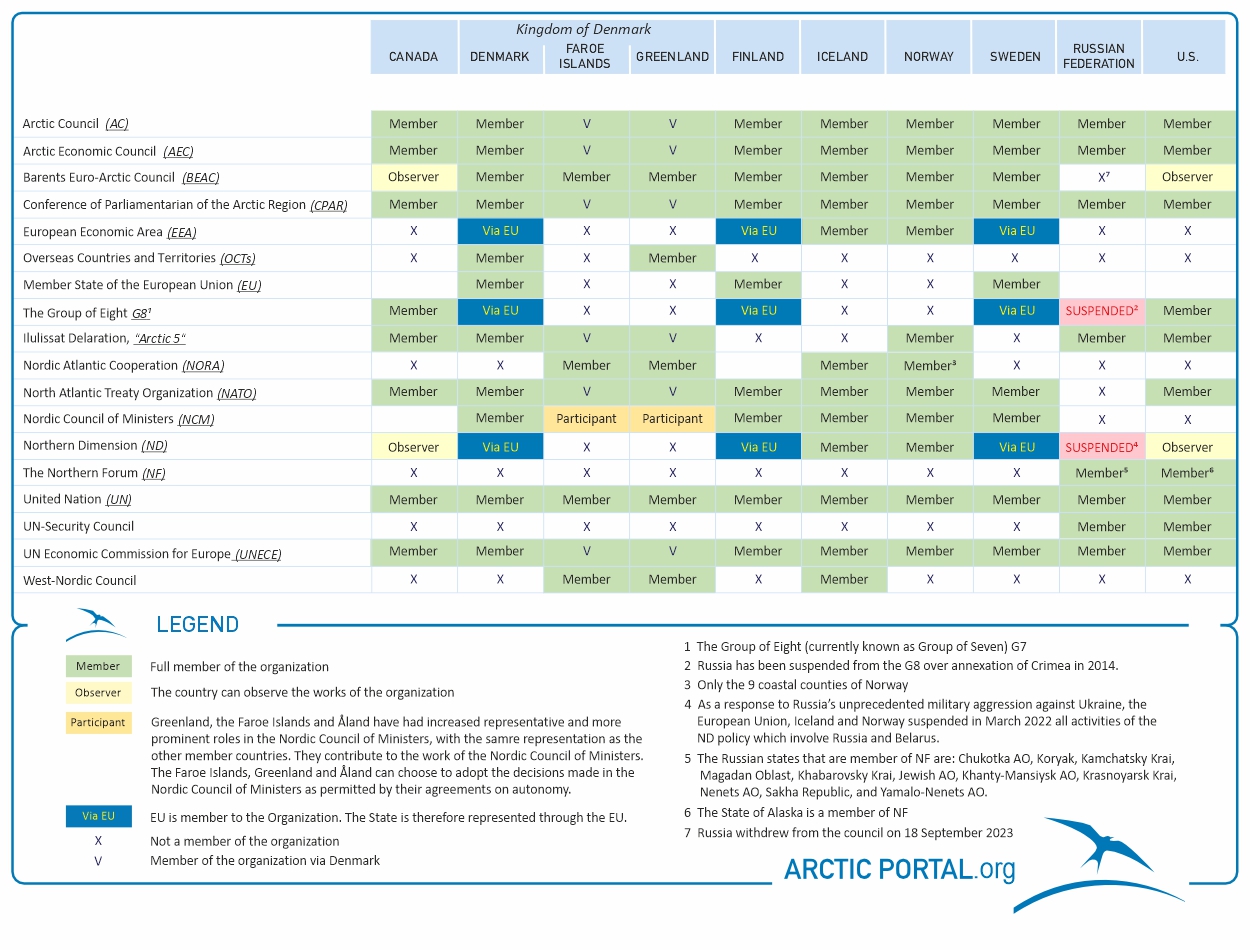
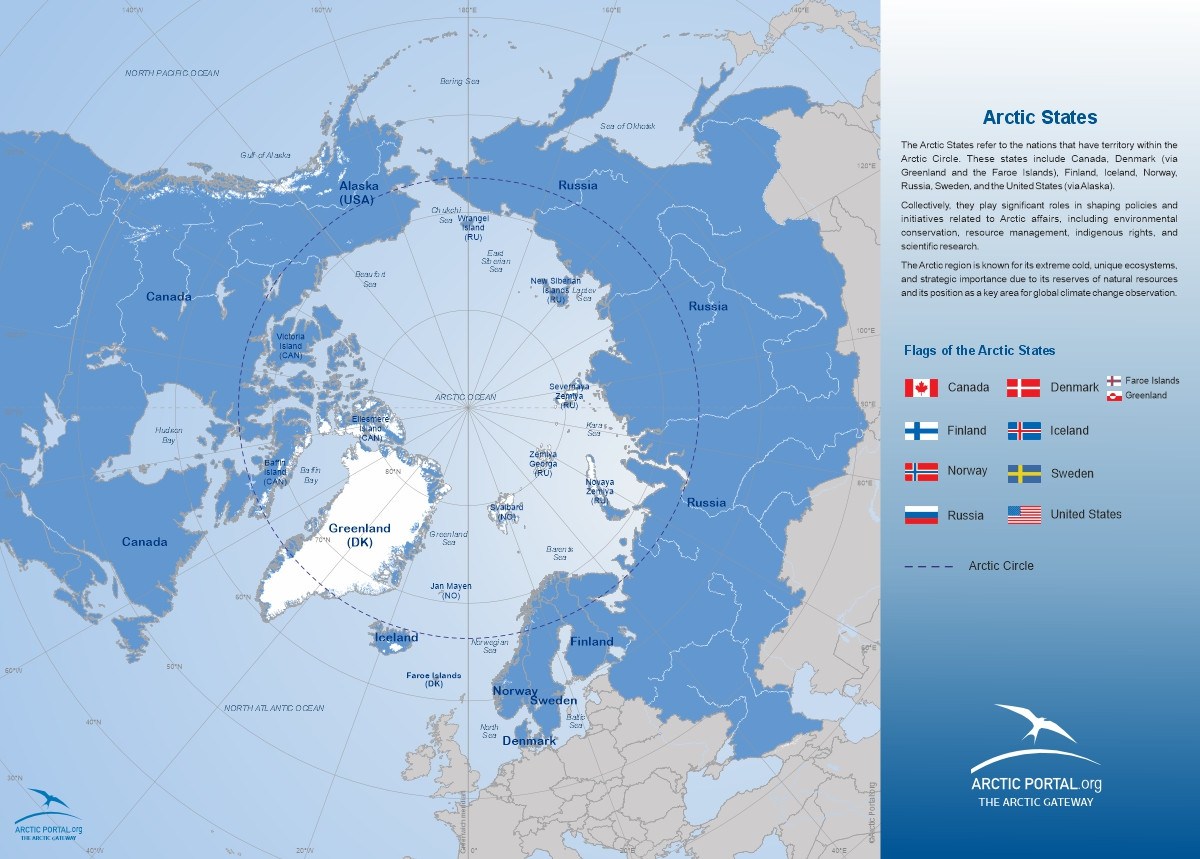
Overview
Arctic Council
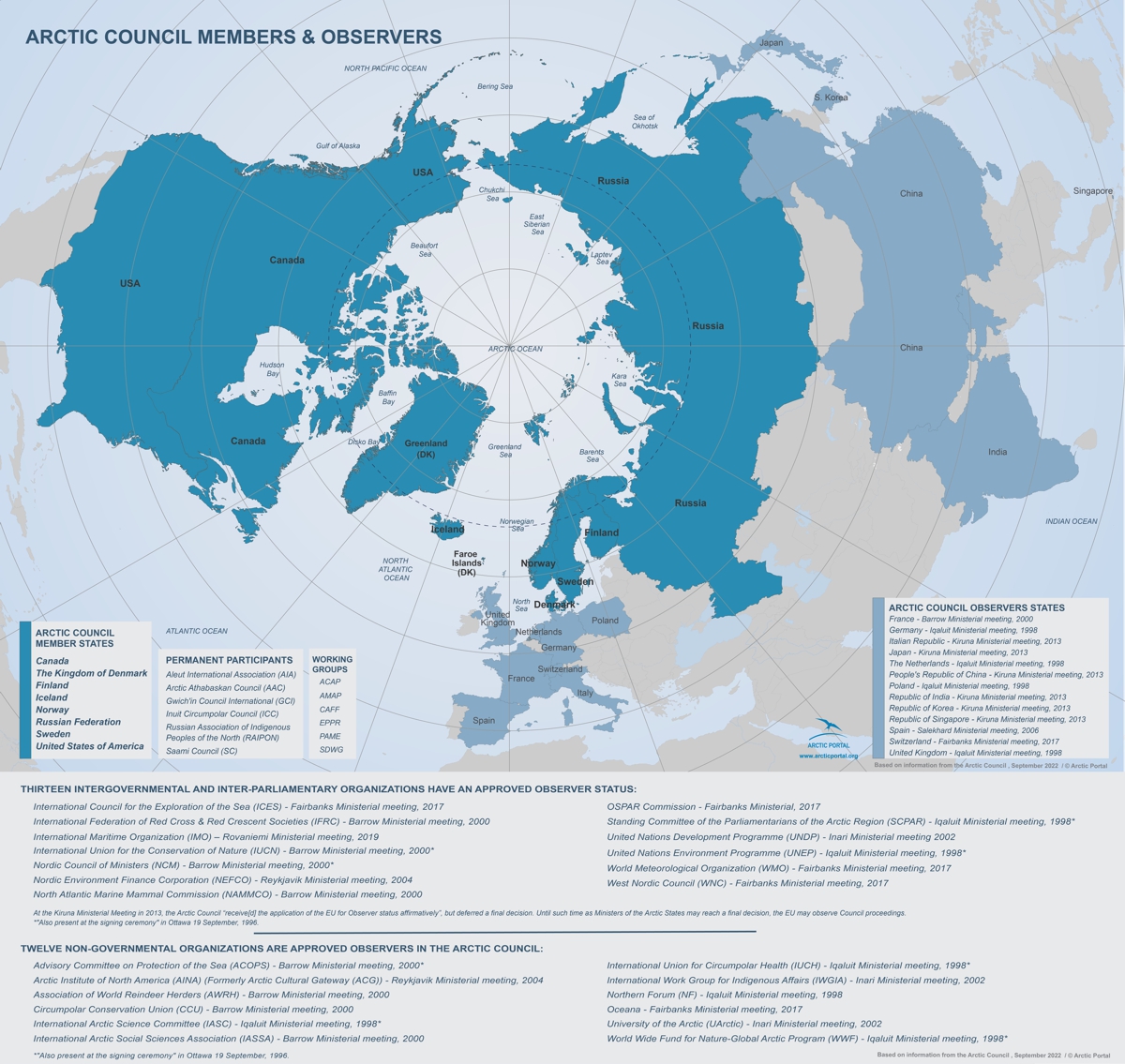 The Arctic Council is the leading intergovernmental forum promoting cooperation, coordination, and interaction among the Arctic states, Arctic Indigenous communities, and other Arctic inhabitants on common Arctic issues, in particular, on issues of sustainable development and environmental protection in the Arctic.
To view the map in higher resolution or to buy and download please click the link.
The work of the Council is primarily carried out in six Working Groups:
- The Arctic Contaminants Action Program (ACAP) acts as a strengthening and supporting mechanism to encourage national actions to reduce emissions and other releases of pollutants.
- The Arctic Monitoring and Assessment Programme (AMAP) monitors the Arctic environment, ecosystems, and human populations, and provides scientific advice to support governments as they tackle pollution and the adverse effects of climate change.
- The Conservation of Arctic Flora and Fauna Working Group (CAFF) addresses the conservation of Arctic biodiversity, working to ensure the sustainability of the Arctic’s living resources.
- The Emergency Prevention, Preparedness, and Response Working Group (EPPR) works to protect the Arctic environment from the threat or impact of an accidental release of pollutants or radionuclides.
- The Protection of the Arctic Marine Environment (PAME) Working Group is the focal point of the Arctic Council’s activities related to the protection and sustainable use of the Arctic marine environment.
- The Sustainable Development Working Group (SDWG) works to advance sustainable development in the Arctic and to improve the conditions of Arctic communities as a whole.
Member States
Canada, the Kingdom of Denmark, Finland, Iceland, Norway, the Russian Federation, Sweden and the United States
Permanent Participants
Aleut International Association (AIA), Arctic Athabaskan Council (AAC), Gwich'in Council International (GCI), Inuit Circumpolar Council (ICC), Russian Association of Indigenous Peoples of the North (RAIPON), Saami Council (SC)
Observers
- States: France, Germany, the Netherlands, Poland, Spain, United Kingdom, People’s Republic of China, Italian Republic, Republic of Korea, Republic of Singapore, Republic of India
- Non-Governmental Organizations: Advisory Committee on Protection of the Seas (ACOPS), Arctic Institute of North America (AINA)—Formerly Arctic Cultural Gateway (ACG), Association of World Reindeer Herders (AWRH), Circumpolar Conservation Union (CCU), International Arctic Science Committee (IASC), International Arctic Social Sciences Association (IASSA), International Union for Circumpolar Health (IUCH), International Work Group for Indigenous Affairs (IWGIA), Northern Forum (NF), University of the Arctic (UArctic), World Wide Fund for Nature-Global Arctic Program (WWF)
Chairship
The chairship of the Council rotates among the eight member states, each state holding the position for two years at a time. Denmark is currently holding the Arctic Council Chairship (2025-2027).
Learn more about the Arctic Council on our Arctic Portal page. Website: http://www.arctic-council.org/
Arctic Economic Council (AEC)
The Arctic Economic Council (AEC) is an independent organization that facilitates Arctic business-to-business activities and responsible economic development through the sharing of best practices, technological solutions, standards, and other information. It works closely with the Arctic Council membership, providing advice and a business perspective on specific areas of cooperation in the circumpolar region. Our members represent a wide range of businesses operating in the Arctic—from mining and shipping companies to reindeer herding and Aboriginal Economic Development Corporations. This mix of interests ensures that our work is carried out in an inclusive and sustainable manner.
Members
- The eight Arctic States: Canada, the Kingdom of Denmark, Finland, Iceland, Norway, the Russian Federation, Sweden and the United States
- The six Permanent Participants: Aleut International Association (AIA), Arctic Athabaskan Council (AAC), Gwich'in Council International (GCI), Inuit Circumpolar Council (ICC), Russian Association of Indigenous Peoples of the North (RAIPON), Saami Council (SC)
Website: http://arcticeconomiccouncil.com/
Arctic Mayors Forum
The Arctic Mayors’ Forum is an organization that aims to give local governments a voice in the development of the Arctic. Until now, the Arctic governance system has offered no formalized and structured procedure for local communities to be involved on a continuous basis in Arctic policymaking.
In 2017, mayors and elected leaders came together in Fairbanks to discuss the need to create a common platform for cooperation to advocate the interests of the peoples and communities in the Arctic. Mayors are trusted with representing their citizens’ best interests, and many communities in the Arctic region face similar situations and can benefit from cross-border cooperation with other local governments.
Formally established in 2019, AMF’s Mission is to ensure the participation of mayors and elected community leaders at Arctic governance tables to ensure that the values, goals, and interests of Arctic peoples are voiced and considered.
The common goal is for our citizens to have good lives, lived in sustainably developed and resilient communities. We stand behind the idea that the challenges and opportunities the Arctic faces require sustained and meaningful engagement with local leaders.
Membership and governance
Arctic Mayors Forum has 18 members, representing local governments in the Arctic states of Canada, Greenland, Finland, Iceland, Norway, Sweden, and the USA https://arcticmayors.com/members/ Membership in the AMF is open to mayors and elected leaders of local governments located in the Arctic states.
The Mayor of Tromsø, Gunnar Wilhelmsen, is the Chair of the Forum for the period of 2023-2025. The AMF follows the Arctic Council Chairship rotation. The first chairman of the Forum was Ásthildur Sturludóttir, Mayor of Akureyri from 2019-2022.
Secretariat
The AMF´s Secretariat is permanently located in Tromsø, Norway, and was officially opened by the Norwegian Minister of Foreign Affairs in January 2023.
Website: https://arcticmayors.com
Barents Euro-Arctic Council (BEAC)
 Cooperation in the Barents Euro-Arctic Region was launched in 1993 on two levels: intergovernmental (Barents Euro-Arctic Council; BEAC) and interregional (Barents Regional Council; BRC), with sustainable development as the overall objective. The region was an area of military confrontation during the Cold War. The underlying premise was that close cooperation secures political long-term stability and reduces possible tensions. This objective has already been successfully achieved. The Barents cooperation has fostered a new sense of unity and closer contact among the people of the region which is an excellent basis for further progress. On 18 September 2023, the MFA of Russia declared Russia´s official withdrawal from the BEAC - read the statement.
To view the map in higher resolution or to buy and download please click the link.
Members
Denmark, Finland, Iceland, Norway, Russia (withdrew from the council on 18 September 2023), Sweden and the European Commission.
Chairship
The chair of the Barents Euro-Arctic Council rotates between Finland, Norway, Russia, and Sweden. The interim Trio Presidency of the Barents Euro-Arctic Council (BEAC) of Finland, Norway and Sweden follows the Finnish Presidency (2021-2023) for a one-year period unless otherwise decided.
Website: http://www.beac.st/
Barents Regional Council (BRC)
The Barents Regional Council unites 14 member counties and a representative of the indigenous peoples in the northernmost parts of Finland, Norway, Sweden, and Russia.
- In Finland: Kainuu, Lapland, and Oulu Region (North Karelia was granted an observer status in 2008)
- In Norway: Finnmark, Nordland and Troms
- In Russia: Arkhangelsk, Karelia, Komi, Murmansk, and Nenets (withdraw from the council on 18 September 2023)
- In Sweden: Norrbotten and Västerbotten
Indigenous Peoples in the Barents Region
- Sami (in Norway, Sweden, Finland and Russia)
- Nenets (in Russia)
- Veps (in Russia)
Website: https://barents-council.org/barents-regional-council/about-the-council
Conference of Parliamentarians of the Arctic Region (CPAR)
The Conference of Parliamentarians of the Arctic Region is a biennial conference for parliamentarians representing the eight Arctic countries and the European Parliament. The first Parliamentary Conference concerning Arctic cooperation was held in Reykjavik, Iceland in 1993. The next conference will be held in Russia in 2016. One of the main priorities of the Standing Committee was originally to support the establishment of the Arctic Council. Since then the Standing Committee has worked actively to promote the work of the Council and participates in the meetings of the Arctic Council as an observer. Today the Committee is engaged in topics such as shipping possibilities, education and research, human development, and climate change.
Members
Canada, Denmark, Finland, Iceland, Norway, Russia, Sweden, the U.S. and the European Parliament
The conference also includes:
Permanent Participants
Aleut International Association (AIA), Arctic Athabaskan Council (AAC), Gwich'in Council International (GCI), Inuit Circumpolar Council (ICC), Russian Association of Indigenous Peoples of the North (RAIPON), Saami Council (SC)
Observers
- States: France, Germany, the Netherlands, Poland, Spain, United Kingdom, People’s Republic of China, Italian Republic, Japan, Republic of Korea, Republic of Singapore, Republic of India
- Non-Governmental Organizations: Advisory Committee on Protection of the Seas (ACOPS), Arctic Institute of North America (AINA)—Formerly Arctic Cultural Gateway (ACG), Association of World Reindeer Herders (AWRH), Circumpolar Conservation Union (CCU), International Arctic Science Committee (IASC), International Arctic Social Sciences Association (IASSA), International Union for Circumpolar Health (IUCH), International Work Group for Indigenous Affairs (IWGIA), Northern Forum (NF), University of the Arctic (UArctic), World Wide Fund for Nature-Global Arctic Program (WWF)
Website: http://www.arcticparl.org/
European Economic Area (EEA)
The Agreement on the European Economic Area, which entered into force on 1 January 1994, brings together the EU Member States and the three EEA EFTA States—Iceland, Liechtenstein, and Norway—in a single market, referred to as the “Internal Market”.The EEA Agreement also states that when a country becomes a member of the European Union, it shall also apply to become party to the EEA Agreement (Article 128), thus leading to an enlargement of the EEA. The EEA Agreement provides for the inclusion of EU legislation covering the four freedoms—the free movement of goods, services, persons, and capital—throughout the 31 EEA States. In addition, the Agreement covers cooperation in other important areas such as research and development, education, social policy, the environment, consumer protection, tourism, and culture, collectively known as “flanking and horizontal” policies. The Agreement guarantees equal rights and obligations within the Internal Market for citizens and economic operators in the EEA.
Members
EU Member States + Iceland, Liechtenstein, and Norway.
Overseas Countries and Territories (OCTs)
Thirteen Overseas Countries and Territories (OCTs) are associated with the European Union. The OCTs are in the Atlantic, Antarctic, Arctic, Caribbean, Indian, and Pacific regions. All are islands, and one of them has no permanent population. The Overseas Countries and Territories (OCTs) are not sovereign countries but depend constitutionally on three EU Member States: Denmark, France, and the Netherlands. Their location, as well as their natural wealth, grants them significant advantages as does their role as European outposts in their respective regions. At the same time, they are all vulnerable to external shocks and are in general dependent on a narrow economic base that mostly revolves around services. In this light, the objective of the partnership with the EU consists of enhancing the OCTs’ competitiveness, strengthening their resilience, reducing their economic and environmental vulnerability, and promoting cooperation between them and other partners. Specific arrangements are therefore established regarding trade and trade-related cooperation, while financial cooperation is foreseen in order to assist OCTs in their sustainable development.
As a result of Brexit, the number of Overseas Countries and Territories associated with the EU has been reduced from 25 to 13.
List of Overseas Countries and Territories
Greenland (Denmark), Aruba (Netherlands), Bonaire (Netherlands), Curaçao (Netherlands), Saba (Netherlands), Sint-Eustatius (Netherlands), Sint-Maarten (Netherlands), French Polynesia (France), French Southern and Antarctic Lands (France), New Caledonia (France), Saint Barthèlemy (France), Saint-Pierre and Miquelon (France), and Wallis and Futuna Islands (France).
Website: https://international-partnerships.ec.europa.eu/countries/overseas-countries-and-territories_en
European Union (EU)
The EU is a unique economic and political partnership between 27 European countries that together cover much of the continent. The EU was created in the aftermath of the Second World War. The first step was to foster economic cooperation: the idea being that countries who trade with one another become economically interdependent and so more likely to avoid conflict. The result was the European Economic Community (EEC), created in 1958, and initially increasing economic cooperation between six countries: Belgium, Germany, France, Italy, Luxembourg and the Netherlands. Since then, a huge single market has been created and continues to develop towards its full potential. What began as a purely economic union has evolved into an organization spanning policy areas, from development aid to the environment. A name change from the EEC to the European Union (EU) in 1993 reflected this. The EU is based on the rule of law: everything that it does is founded on treaties, voluntarily and democratically agreed by all member countries. These binding agreements set out the EU’s goals in its many areas of activity. On 30 March 2019, the United Kingdom left the EU (had been a member since 1973).
Main Institutions of the EU
- The European Parliament is the EU’s law-making body. It is directly elected by EU voters every 5 years. The last elections were in May 2014.
- Council of the European Union: Together with the European Parliament, the Council is the main decision-making body of the EU.
- The European Commission is the EU’s politically independent executive arm. It is alone responsible for drawing up proposals for new European legislation, and it implements the decisions of the European Parliament and the Council of the EU.
Members
27 EU member states, of which Arctic countries are: Finland, Sweden, and Denmark (but with the exclusion of Greenland and Faroe)
G8
The G8, otherwise known as the Group of Eight, is an assembly of world leaders who meet annually to discuss global issues. Each year, the G8 holds a Leaders’ Summit, in which Heads of State and Governments of member countries meet to discuss and attempt to reconcile global issues. Although the G8 is best known for its annual summits, it works throughout the year to tackle important contemporary topics such as the economy and climate change. The G8 discusses and creates global policies. However, adherence to these policies is not obligatory, and other countries can decide whether or not to obey.
Members
The heads of government from Canada, France, Germany, Italy, Japan, the United Kingdom and the United States. The European Union is also represented at meetings by both the president of the European Commission and the leader of the country that has the European Union presidency. The Russian Federation is currently suspended from the G8 over the annexation of Crimea in 2014.
Ilulissat, “Arctic 5”
“The five coastal states currently cooperate closely in the Arctic Ocean with each other and with other interested parties. This cooperation includes the collection of scientific data concerning the continental shelf, the protection of the marine environment, and other scientific research. We will work to strengthen this cooperation, which is based on mutual trust and transparency, inter alia, through timely exchange of data and analyses.” (THE ILULISSAT DECLARATION, ARCTIC OCEAN CONFERENCE, ILULISSAT, GREENLAND, 27-29 MAY 2008)
Members
Canada, Denmark, Norway, the Russian Federation, and the United States of America
Nordic Atlantic Cooperation (NORA)
Nora (Nordic Atlantic Cooperation) is an intergovernmental organization under the Nordic Council of Ministers. The NORA region includes the Faroe Islands, Greenland, Iceland, and Coastal Norway (the 9 coastal counties of Norway, from Finnmark in the north to Rogaland in the south). The NORA countries are associated by their geographical location and by shared characteristics, common challenges, and historical, institutional, and cultural links. NORA’s goal is to contribute to the creation of a vital and dynamic North Atlantic region, characterized by a strong and sustainable economy. To reach this goal, NORA supports collaboration between businesses and research and development organizations in the region. NORA’s main objectives and focus areas are set out in NORA’s strategic program. The Nordic Council of Ministers, supplemented by national grants from the four member countries, finances NORA. The NORA committee, which is comprised of twelve members, three from each of the countries in the NORA region, decides the main focus areas for NORA’s activities. These focus areas are set out in multiple-year strategic programs. NORA’s main secretariat is located in Tórshavn, the Faroe Islands. In addition, regional contact persons are located in Iceland, Greenland, Western Norway, and Northern Norway.
Members
Faroe Islands, Greenland, Iceland, and Coastal Norway (the nine coastal countries of Norway, from Finnmark in the north to Rogaland in the south).
Website: http://www.nora.fo/
North Atlantic Treaty Organization (NATO)
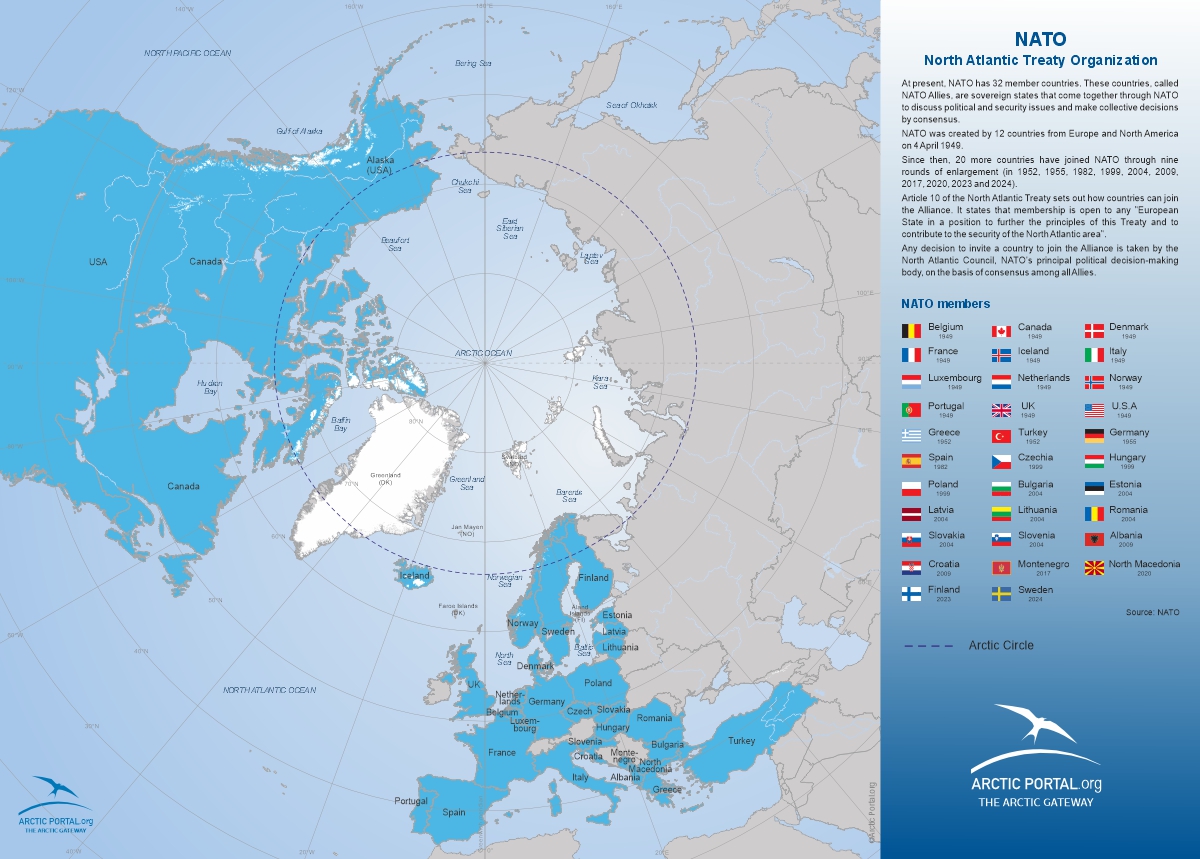 NATO is an alliance of countries from Europe and North America. It provides a unique link between these two continents for consultation and cooperation in the field of defence and security and the conduct of multinational crisis-management operations. NATO's essential purpose is to safeguard the freedom and security of its members through political and military means.
To view the map in higher resolution or to buy and download please click the link.
Political
NATO promotes democratic values and encourages consultation and cooperation on defense and security issues to build trust and, in the long run, prevent conflict.
Military
NATO is committed to the peaceful resolution of disputes. If diplomatic efforts fail, it has the military capacity needed to undertake crisis-management operations. These are carried out under Article 5 of the Washington Treaty—NATO’s founding treaty—or under a UN mandate, alone or in cooperation with other countries and international organizations.
NATO is committed to the principle that an attack against one or several members is considered as an attack against all. This is the principle of collective defense, which is enshrined in Article 5 of the Washington Treaty. So far, Article 5 has been invoked once—in response to the 9/11 terrorist attacks in the United States.
Members
32 states, of which Arctic countries are: Canada, Denmark, Finland, Iceland, Norway, Sweden, and the U.S.
Nordic Council of Ministers (NCM)
The Nordic Council of Ministers is the official body for intergovernmental cooperation in the Nordic Region. Overall responsibility for cooperation lies with the prime ministers, but in practice, it is delegated to the ministers for Nordic cooperation. The Nordic Council of Ministers was founded in 1971 and, despite its name, actually consists of several individual councils of ministers. Nordic ministers for specific policy areas meet in their respective councils of ministers a couple of times a year. There are currently 10 constellations of councils of ministers for specific policy areas as well as the council of ministers for the ministers for cooperation. Decisions in all of the councils of ministers must be unanimous. The Presidency of the Nordic Council of Ministers, which is held for a period of one year, rotates between the five Nordic countries. The country holding the Presidency of the Nordic Council of Ministers draws up a program to guide Nordic cooperation during the year. Matters are prepared and followed up by the various committees of senior officials, which consist of civil servants from the member countries.
Member countries and territories
Denmark, Finland, Iceland, Norway, and Sweden have been members of the Nordic Council of Ministers since 1971. In addition, Greenland, the Faroe Islands, and Åland have also had increased representation and more prominent roles in the Nordic Council of Ministers, with the same representation as the other member countries.
Website: http://www.norden.org/
Northern Dimension (ND)
The Northern Dimension is a joint policy between the EU, Russia, Norway, and Iceland. The ND Policy was initiated in 1999 and renewed in 2006. The policy aims to provide a framework for:
- promote dialogue and concrete cooperation;
- strengthen stability, well-being and intensified economic cooperation;
- promote economic integration, competitiveness, and sustainable development in Northern Europe.
Partners
EU, Russia, Norway and Iceland
Participants
- EU Member States in their national capacity
- Regional Councils, the Arctic Council (AC), the Barents Euro-Arctic Council (BEAC), the Council of the Baltic Sea States (CBSS) and the Nordic Council of Ministers (NCM)
- International Financial Institutions (IFIs), e.g. European Bank for Reconstruction and Development (EBRD), the European Investment Bank (EIB), the Nordic Investment Bank (NIB), and the Nordic Environment Finance Corporation (NEFCO) as well as other financial institutions
- Universities, research centers, and the business community
- Canada and the United States as observers
- Belarus participates in practical cooperation
The Northern Forum (NF)
The Northern Forum is a membership-based international organization. Northern regions share characteristics that set them apart from other areas of the world. These include:
- Economies based upon the extraction of natural resources
- Lack of internal capital resources
- Limited infrastructural development
- Harsh climates and vulnerable ecosystems
- Diverse and relatively strong indigenous cultures
- Sparse populations
Such complex factors create unique challenges for regional Governors and other executives. From throughout the North, the Northern Forum brings these leaders together to address common political, environmental, and economic issues.
Members
Jewish AutonomousOkrug, Kamchatka Krai, Krasnoyarsk Krai, MagadanOblast, Nenets Autonomous Okrug, Sakha Republic (Yakutia), KhabarovskKrai, Khanty-Mansyisk Autonomous Okrug - Yugra, Chukotka Autonomous Okrug, Yamal-Nenets Autonomous Okrug, State of Alaska (USA), Gangwon Province (Republic of Korea), as well as 9 business partners from the Russian Federation, Iceland, Norway, USA, and Japan.
Website: http://www.northernforum.org/
United Nations (UN)
The United Nations is an international organization founded in 1945. It is currently made up of 193 Member States. The mission and work of the United Nations are guided by the purposes and principles contained in its founding Charter. Due to the powers vested in its Charter and its unique international character, the United Nations can take action on the issues confronting humanity in the 21st century, such as peace and security, climate change, sustainable development, human rights, disarmament, terrorism, humanitarian and health emergencies, gender equality, governance, food production, and more. The UN also provides a forum for its members to express their views in the General Assembly, the Security Council, the Economic and Social Council, and other bodies and committees. By enabling dialogue between its members, and by hosting negotiations, the Organization has become a mechanism for governments to find areas of agreement and solve problems together.
Website: http://www.un.org/
UN–Security Council
Under the United Nations (UN) Charter, the Security Council has primary responsibility for the maintenance of international peace and security. It has 15 Members, and each Member has one vote. Under the Charter, all Member States are obligated to comply with Council decisions. The Security Council takes the lead in determining the existence of a threat to the peace or act of aggression. It calls upon the parties to a dispute to settle it by peaceful means and recommends methods of adjustment or terms of settlement. In some cases, the Security Council can resort to imposing sanctions or even authorizing the use of force to maintain or restore international peace and security. The Security Council also recommends to the General Assembly the appointment of the Secretary-General and the admission of new Members to the United Nations. And, together with the General Assembly, it elects the judges of the International Court of Justice.
Members—the Council is composed of 15 Members:
- five permanent members: China, France, the Russian Federation, the United Kingdom, and the United States,
- and ten non-permanent members elected for two-year terms by the General Assembly (with end-of-term date): Belgium (2020) Côte d’Ivoire (2019) Dominican Republic (2020) Equatorial Guinea (2019) Germany (2020) Indonesia (2020) Kuwait (2019) Peru (2019) Poland (2019) South Africa (2020)
Website: https://www.un.org/securitycouncil/
UN Economic Commission for Europe (UNECE)
The United Nations Economic Commission for Europe (UNECE) was set up in 1947 by ECOSOC.UNECE’s major aim is to promote pan-European economic integration. To do so, it brings together 56 countries located in the European Union, non-EU Western and Eastern Europe, South-East Europe and the Commonwealth of Independent States (CIS), and North America. All these countries dialogue and cooperate under the aegis of UNECE on economic and sectoral issues. However, all interested United Nations member States may participate in the work of UNECE. Over 70 international professional organizations and other non-governmental organizations take part in UNECE activities.
Members
56 countries (including the 8 Arctic states)
Website: http://www.unece.org/mission.html
West Nordic Council
The special cultural and geographic conditions of the Faroe Islands, Greenland, and Iceland were subject to political discussions in the early 1980s. Subsequently, the West Nordic Countries agreed to establish a joint parliamentary organization. The chief aim would be to cooperate on common problems and to conduct positive and constructive cooperation regarding West Nordic, or North Atlantic, issues with the Nordic Council as well as with other organizations. The West Nordic Parliamentarian Council of Cooperation was formed in 1985. In 1997 the name was changed to the West Nordic Council as the member parliaments approved the Council’s present Charter. The parliaments of Greenland, Iceland, and the Faroe Islands each appoint six representatives to the West Nordic Council—i.e. a total of 18 members.
Main Objectives of the West Nordic Council
- To promote West Nordic (North Atlantic) interests
- To be guardians of North Atlantic resources and North Atlantic culture and to help promote West Nordic interests through the West Nordic governments—not least concerning the serious issues of resource management, pollution, etc.
- To follow up on the governments’ West Nordic cooperation
- To work with the Nordic Council and to be the West Nordic link in Nordic cooperation
- To act as the parliamentary link for inter-West Nordic organizations, including Arctic parliamentary cooperation
Members
Faroe Islands, Greenland and Iceland
Website: https://www.vestnordisk.is/english/
- Details
- Written by: ofurpaur
- Category: Site Content
- Hits: 35850
Background
As result of climate change effects and concomitant environmental stressors, the Arctic region has been changing rapidly. During the last few decades, researchers, politicians, and other stakeholders from the economical sector follow these changes with great interest. The transitional phase the Arctic is experiencing oscillates between two possible scenarios:
- A very big advance of the economic development and environmental integrity benefitting local and global communities
- Or, social, environmental or even new economic threats caused by lack of adaptation.
The environment and the local population are already experiencing most of the severe threats announced, while the economical advantages are being continuously pushed back. In fact, while shipping industries, for example, are looking forward to intensively use the Northern sea routes, companies for insurance broking and risk management are not ready to accommodate their requests. Moreover, while people in the Northern regions are willing to adapt to these radical changes, the infrastructures needed to exploit and benefit from new opportunities have not being built yet.
Partners to Arctic Data Interface - Visualization & Comparison Tool (ADI) have identified "uncertainty" as one of the main obstacles to a positive economic development of the region, which is, at the same time, also hampering politicians, decision-makers and other stakeholders to take decisions capable to attenuate the negative effects of climate change from Arctic to global level. "Uncertainty" regarding Arctic environmental trends and socioeconomic dynamics can be attenuated only by providing knowledge and making data available from local to global level. Profound research on Arctic change in the 21st Century has produced a broad range of knowledge about past and present local conditions but global climate models project regionally different future scenarios. Moreover, the existing scientific insights and information is not integrated to each other.
The ADI project
ADI will gather the best existing research documents, data and metadata from a number of data centers, institutes, and web server. It will standardize the datasets and feed them into a modern permanent system for metadata and data access, visualization, and presentation, facilitating the conversion of data and information into knowledge. Specifically, the ADI makes a showcase with cryosphere and permafrost, that demonstrates processes and methodologies. Other topics will be developed with the growth of the project, chaining topics and filling knowledge gaps.
The ADI enables online to add, crosscut and compare other sets of data from economical, business, social, and political sectors. The scope of this new system for data comparison is to serve all professionals which need to gain a comprehensive and numerical understanding of the region. The main stakeholders are investors, business analysts, politicians, but also researchers, academic and students. In addition, the ADI is strongly aimed to facilitate the development of business and market opportunities, as it will drastically lower the knowledge uncertainness now hampering a sustainable and profitable development of Arctic resources.
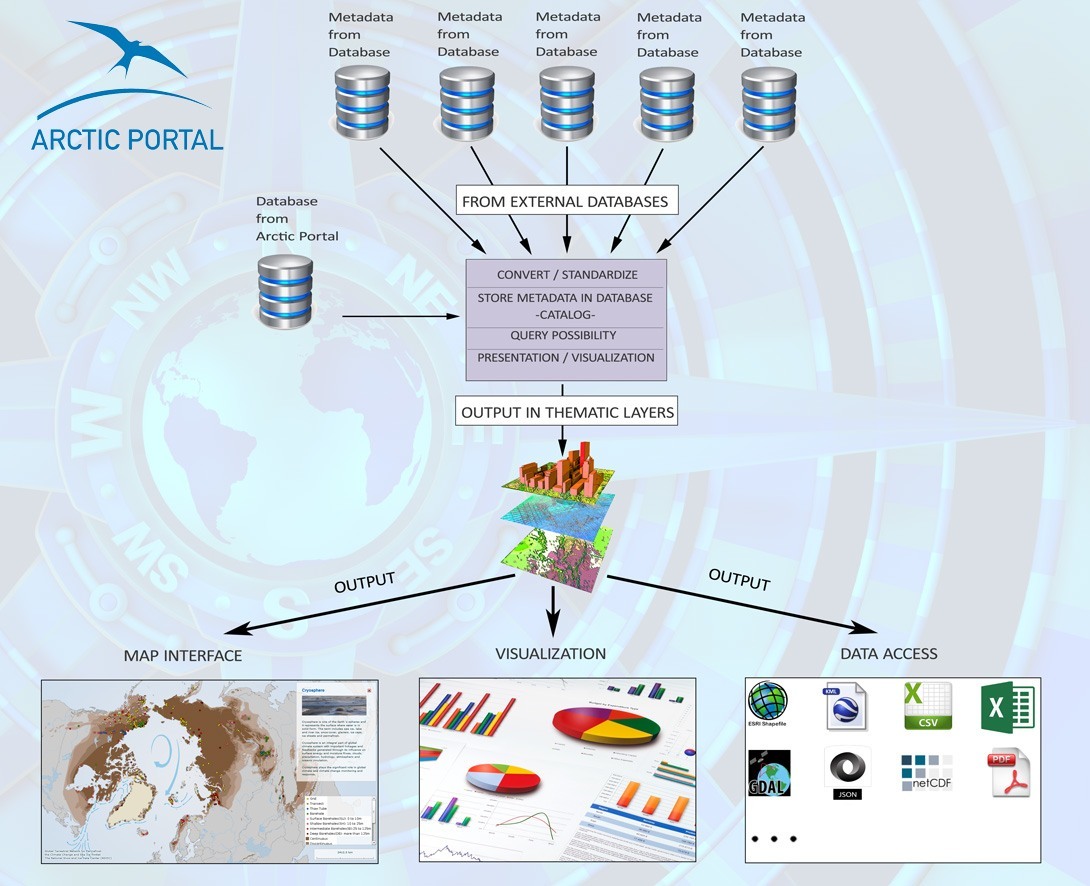
Workflow diagram of the Arctic Data Interface System
Showcases
Arctic Portal interactive Mapping System
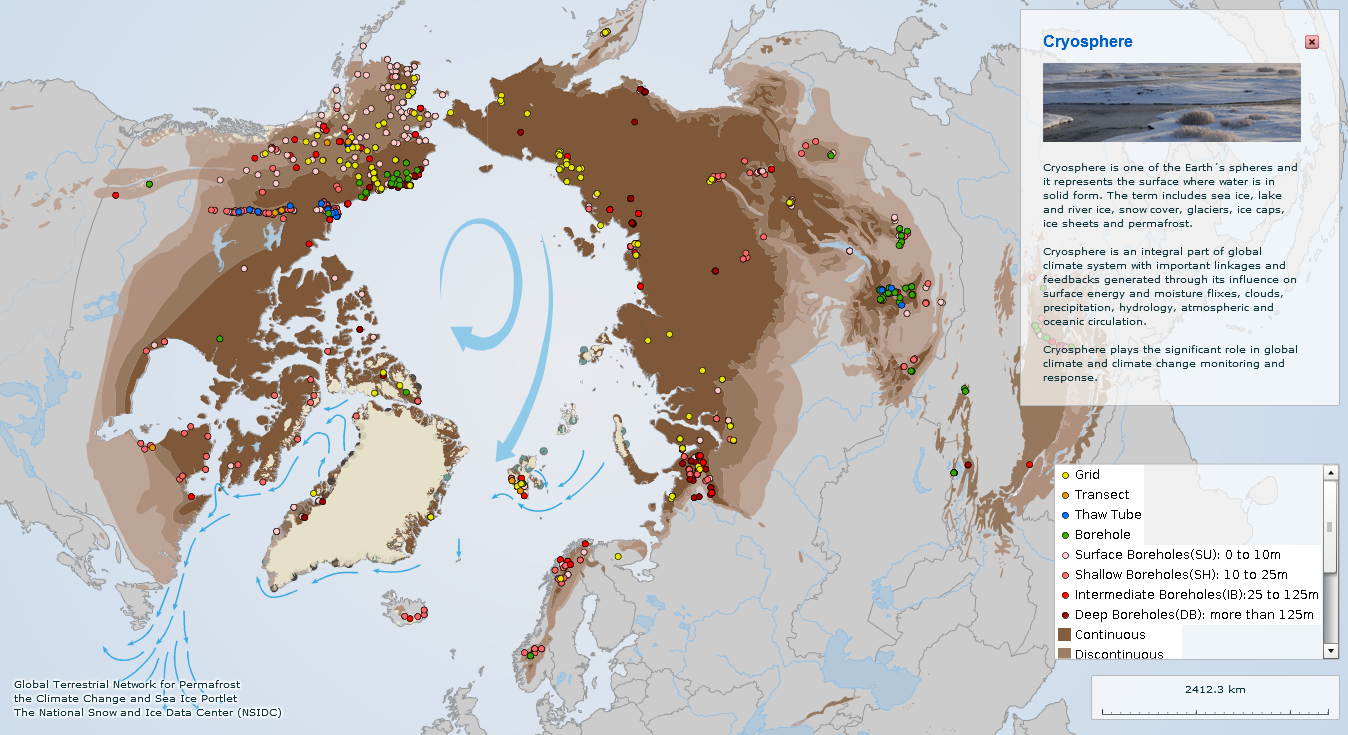
Arctic Portal Mapping System provides visual information about Arctic related information through various databases. The system is powered by the Inter-Map mapping system, developed by the Arctic Portal staff. All data utilized to create our maps are provided either from our partners (see Arctic Portal Community) either from the best reliable databases currently available. Sources are always quoted clearly.
Arctic Portal staff is continuously working to update the mapping system and to create new maps. If you need a map in a different resolution as the one provided, please contact
In addition, Arctic Portal Staff can create customized maps. You can visualize all layers available in our Inter-Map mapping system. Arctic Portal staff will export the map with the layers requested into file. Please contact us for any additional information.
 |
||
| Arctic Portal Interactive Mapping System in Polar projection |
Project Page 21 and the GTN-P DMS (Global Terrestrial Network for Permafrost Data Management System):
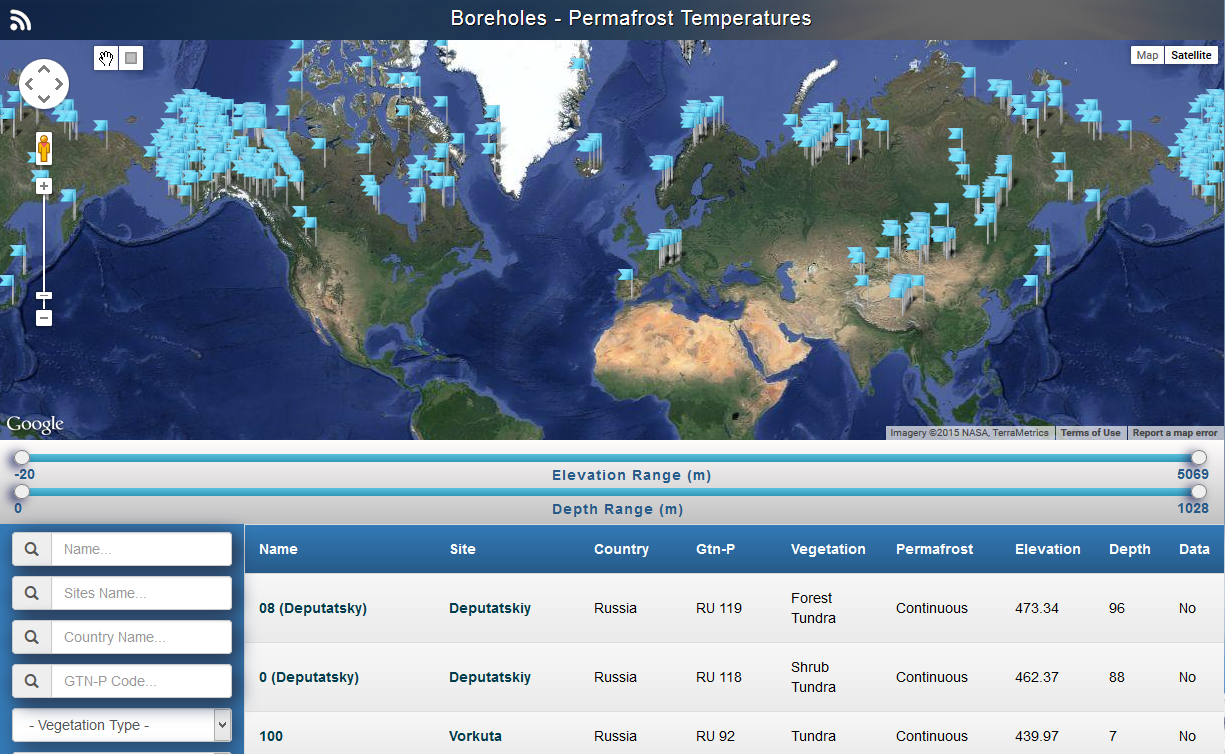
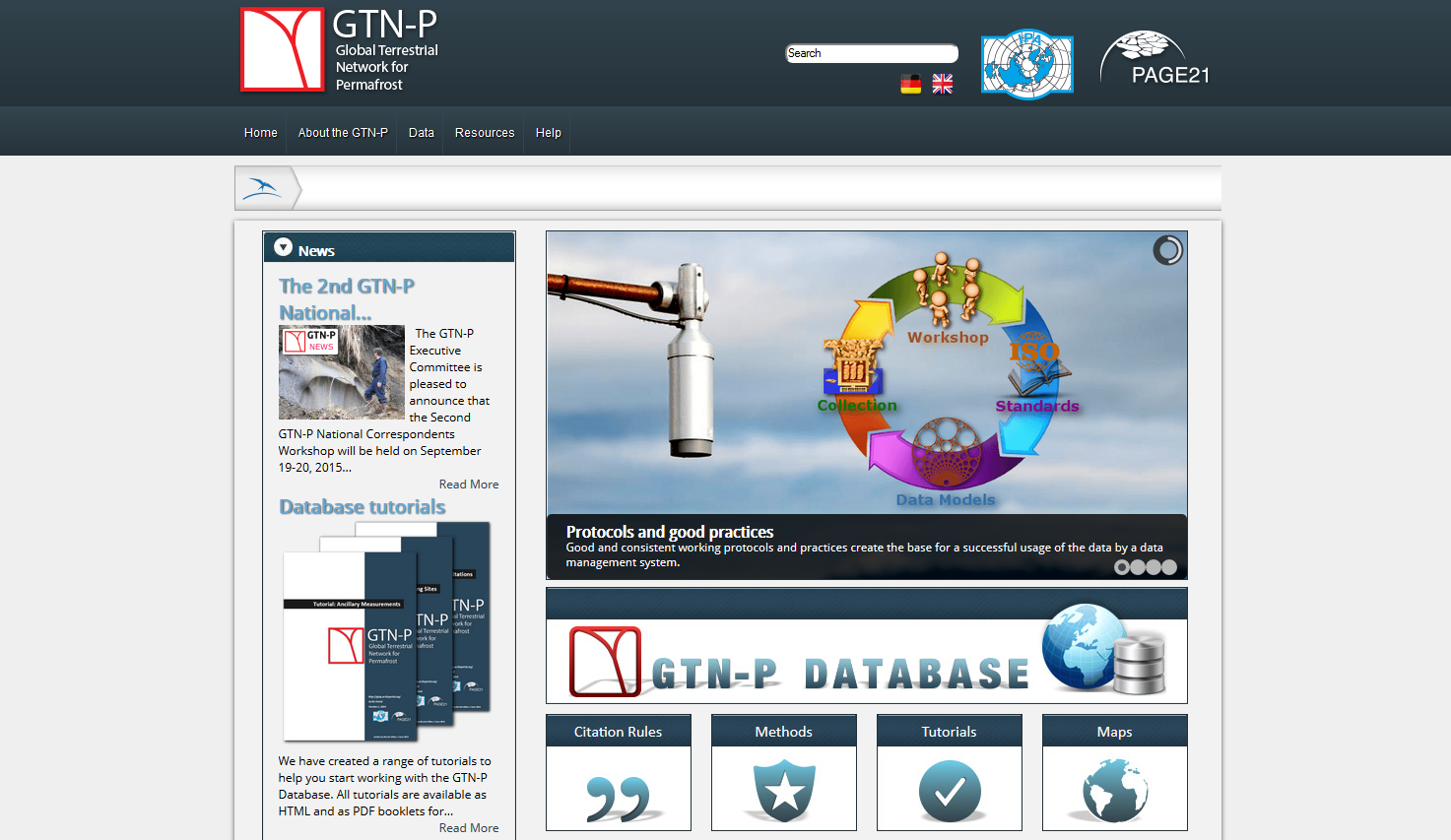
Within the European 7th Framework programme project: Changing Permafrost in the Arctic and its Global Effects on the 21st Century (Page21), Arctic Portal organizes and develops the first standardize global data sets for Permafrost Temperature and Active Layer thawing depths. the web-based Data Management System represents 1087 boreholes and 243 Active layer monitoring sites in all permafrost zones of the world, with 600 other sites to come soon (access the resources here). A great lack of organization exists within In situ terrestrial monitoring networks and the Data Management system for permafrost developed by AP is seen as a case for integrating Essential Climate Variables (ECVs) from In situ terrestrial Networks into Earth System Models.
 |
 |
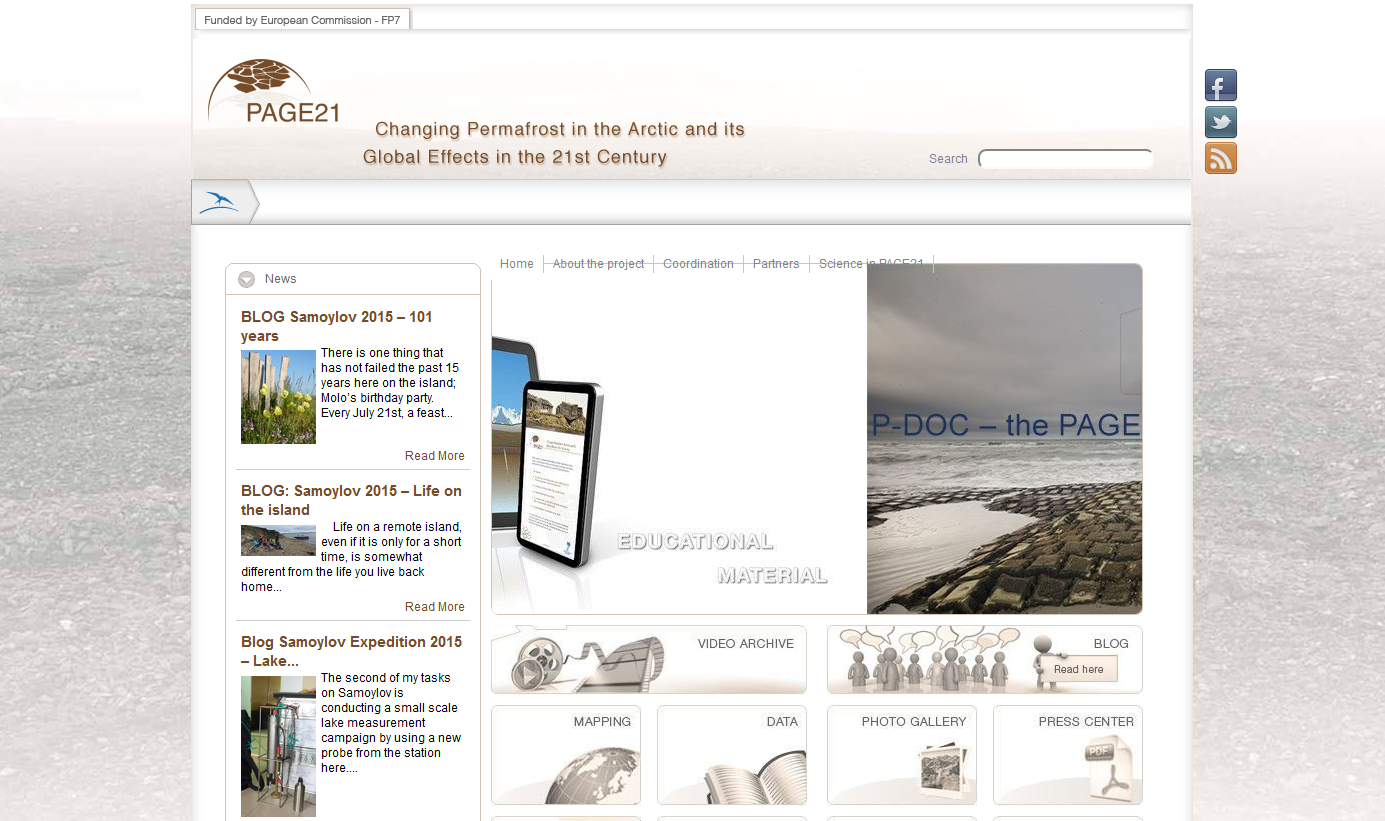 |
| GTN-P Database | GTN-P Website | Project Page21 Website |
AMATII: (The Arctic Transportation Database contains information for maritime and aviation infrastructure):
The Arctic Transportation Database contains information for maritime and aviation infrastructure as depicted on the Interactive Data Map provided by Arctic Portal. 601 airports and 349 ports in the Arctic with their metadata are available and can be searched and downloaded in different formats.
 |
|
| Arctic Infrastructure Database |
The partners
ADI is built in association and with the support of various national and international partners who have recognized the need for integrated and performant tools providing high quality Arctic Information.
 |
 |
 |
 |
 |
 |
 |
 |
- Details
- Written by: ofurpaur
- Category: Site Content
- Hits: 67969
Maps
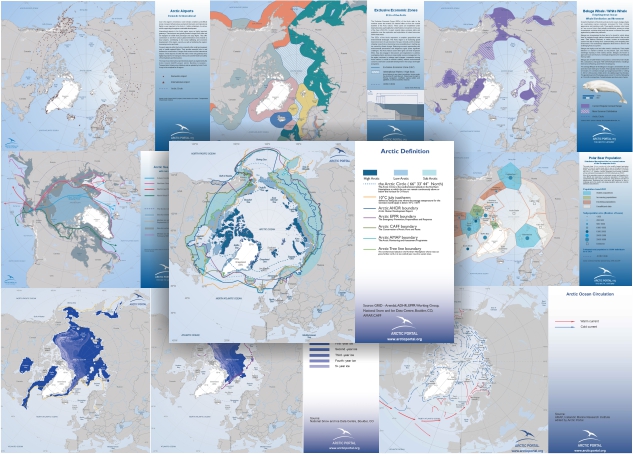
Arctic Portal specializes in creating customized graphical maps that cover a range of significant Arctic topics with global recognition. These subjects include Arctic Definition, Arctic Sea Ice, Shipping, Governance & Arctic Organizations, Arctic flora, Arctic fauna, and Infrastructure.
We consistently update and add new maps to our website, with recent additions encompassing infrastructure layouts, polar bear population distribution, various whale species distributions, walrus habitats, and Arctic shipping routes featuring projections for Northpolar-Canada and Northpolar-Russia.
All the data employed in crafting our maps are sourced either from our partners (see Arctic Portal Community) or from the most reliable and reputable databases currently available. Our commitment to transparency ensures that sources are consistently cited.
A wide selection of our maps is available for viewing, subject to our specified conditions, and can also be purchased for direct download and can then be used for open publication on the condition that the source Arctic Portal is cited.
If you are looking for a map tailored to your specific requirements, we invite you to submit a request to
To view the available maps please click on the picture or the text - Maps Gallery.
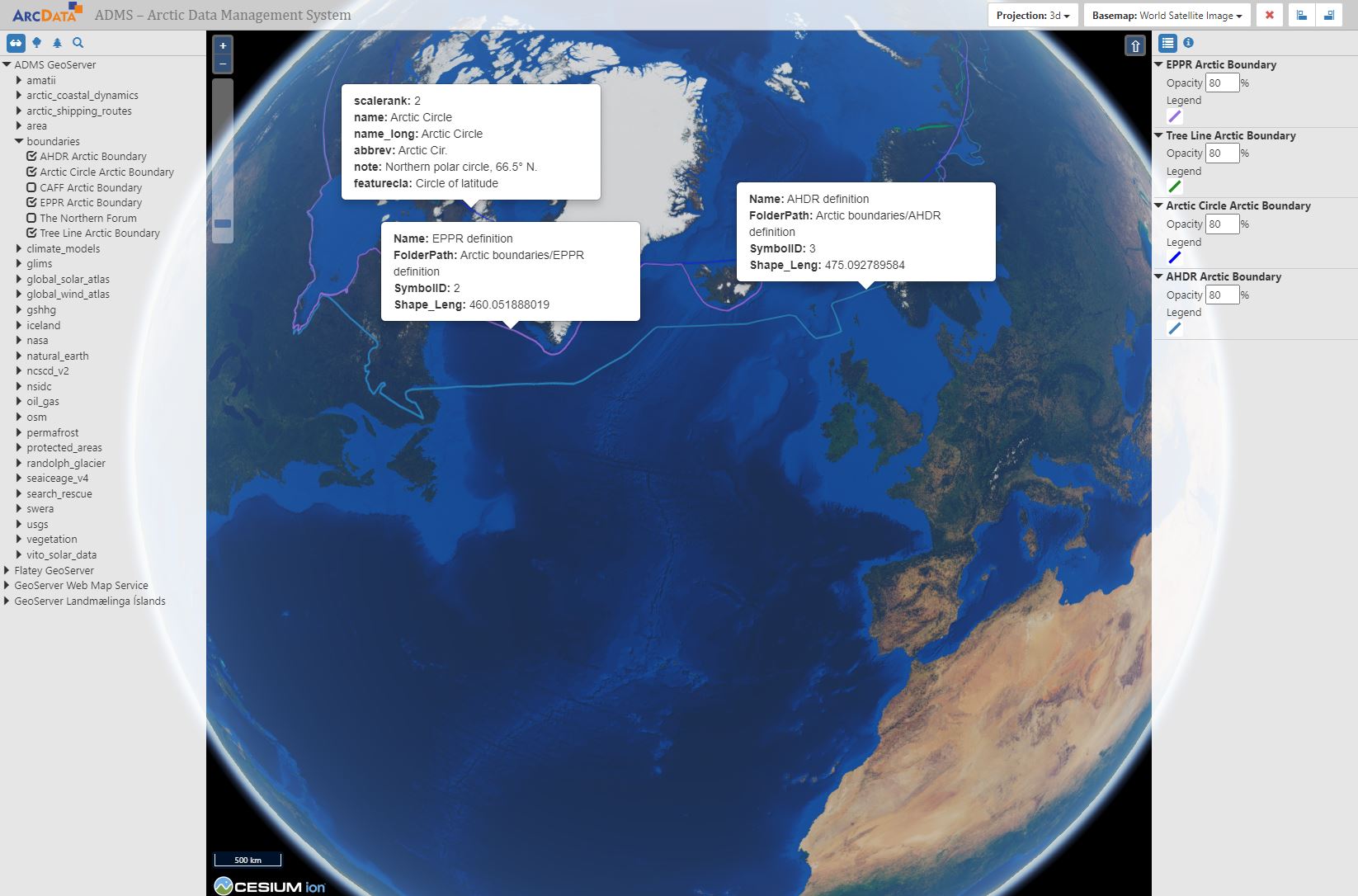
Arctic Portal Interactive Mapping System - ADMS (Arctic Data Management System), developed by the Arctic Portal and ArcData staff, provides visual information and data on the Arctic through a state-of-the-art 3d portal.
The ADMS mapping and data management system is a Web-based GIS application implemented mainly through client-side Web programming.
All data and information layers are either connected through web-services and/or hosted on a Geo Server, owned, controlled and hosted by Arctic Portal - ArcData, shared between different instances of the system.
Discover the power of ADMS as you navigate through various layers of data, encompassing a wide range of Arctic-related information such as ice conditions, shipping routes, social data, energy resources, infrastructure, and more. The system allows you to cross-reference and visualize these datasets, enabling comprehensive analysis and insight into the Arctic's dynamics.
Furthermore, ADMS provides the option to download some of the selected datasets, empowering users to delve deeper into specific areas of interest. Unlock the full potential of ADMS and explore the Arctic like never before.
The ADMS Mapping system is used in the Arctic Council endorsed Arctic Renewable Energy Atlas project (AREA) - Visit the AREA Information System.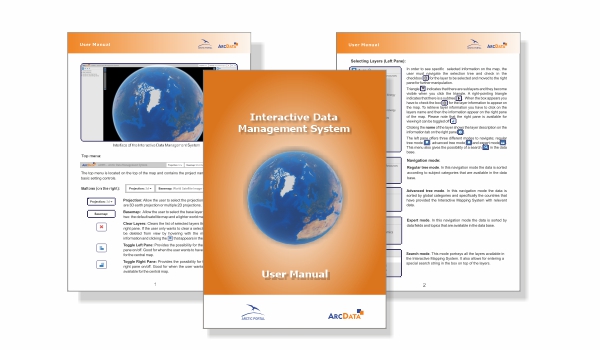
A comprehensive User Manual for the ADMS System & the AREA Information System is available by clicking on the text or the picture. Whether you are a novice or an experienced user, this tutorial will guide you through every aspect of ADMS with clear and concise instructions. Discover the full potential of ADMS and learn how to effectively manage and analyze your data.
The Arctic Portal & ArcData staff is continuously working to update the ADMS Mapping System and to create new maps for our visitors' benefit.
If you want to suggest new maps, or if you think there are any errors, please contact
Arctic Portal.org needs your support to continue its successful journey! - Help us make Arctic Portal.org even better!