
- Details
- Written by: ofurpaur
- Category: Climate Change and Sea Ice
- Hits: 2590
The Intergovernmental Panel on Climate Change (IPCC) is the leading international body for the assessment of climate change. It was established by the United Nations Environment Program (UNEP) and the World Meteorological Organization (WMO) to provide the world with a clear scientific view on the current state of knowledge in climate change and its potential environmental and socio-economic impacts.
The UN General Assembly endorsed the action by WMO and UNEP in jointly establishing the IPCC.
The IPCC is a scientific body. It reviews and assesses the most recent scientific, technical and socio-economic information produced worldwide relevant to the understanding of climate change. It does not conduct any research nor does it monitor climate related data or parameters.
Thousands of scientists from all over the world contribute to the work of the IPCC on a voluntary basis. Review is an essential part of the IPCC process, to ensure an objective and complete assessment of current information.
IPCC aims to reflect a range of views and expertise. The Secretariat coordinates all the IPCC work and liaises with Governments. It is supported by WMO and UNEP and hosted at WMO headquarters in Geneva.
The IPCC is an intergovernmental body. It is open to all member countries of the United Nations (UN) and WMO. Currently 194 countries are members of the IPCC.
Governments participate in the review process and the plenary Sessions, where main decisions about the IPCC work program are taken and reports are accepted, adopted and approved. The IPCC Bureau Members, including the Chair, are also elected during the plenary Sessions.
Because of its scientific and intergovernmental nature, the IPCC embodies a unique opportunity to provide rigorous and balanced scientific information to decision makers. By endorsing the IPCC reports, governments acknowledge the authority of their scientific content. The work of the organization is therefore policy-relevant and yet policy-neutral, never policy-prescriptive.
Source: IPCC
- Details
- Written by: ofurpaur
- Category: Climate Change and Sea Ice
- Hits: 2850
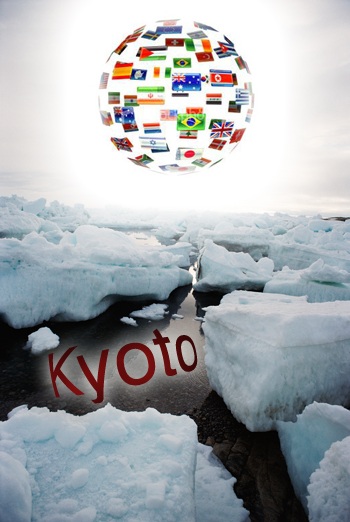
The Kyoto Protocol is a protocol to the United Nations Framework Convention on Climate Change (UNFCCC) in the battle against climate change. It is a treaty that has been signed and ratified by 184 countries with the goal of achieving the "stabilization of greenhouse gas concentrations in the atmosphere at a level that would prevent dangerous anthropogenic interference with the climate system." It entered in force in 2005.
The major feature of the Kyoto Protocol where the targets for 37 industrialized countries and the European Community for reducing greenhouse gas emissions .The target is an average of five per cent against 1990 levels between 2008-2012. In addition to the limits, the Kyoto Protocol introduces three mechanisms how the targets are to be met.
Primarily, the countries must reduce their emissions through national measures, meaning that they have to take action to actually diminish their greenhouse gas pollution. But since the economies of most countries are highly dependent on industries that are high polluters, three other mechanisms were introduced to ease the reduction scheme.
The first mechanism introduced in the Kyoto Protocol is the Emissions Trading. Emissions trading, as set out in Article 17 of the Kyoto Protocol, allows countries that have emission units to spare - emissions permitted them but not "used" - to sell this excess capacity to countries that are over their targets. This scheme is in use for example in the European Union and is one of the largest trading schemes in operation.
Second mechanism provided by the Kyoto Protocol is the Clean Development Mechanism (CDM), defined in Article 12 of the Protocol. The CDM is a purchase system where saleable certified emission reduction (CER) credits can be earned by implementing an emission-reduction project in developing countries. This is a unique global environmental investment system and there exists now 1849 registered CDM project activities.
Third mechanism is so called „joint implementation" ,defined in Article 6 of the Kyoto Protocol. The „joint implementation" allows an Annex II country to earn emission reduction units (ERUs) from an emission-reduction or emission removal project in another Annex II country through a flexible and cost-efficient foreign investment and technology transfer.
Source: The Kyoto Protocol
- Details
- Written by: ofurpaur
- Category: Climate Change and Sea Ice
- Hits: 2144
It is an international treaty on environmental law aiming at reducing the greenhouse gas concentrations in the atmosphere.
The UNFCCC does not lay down any binding limits of reduction, but divides the signatories to the convention in to three categories each category agreeing to reduce their emissions of greenhouse gas a certain amount.
First category of industrialized countries, so called Annex I countries, agree to reduce their emissions of greenhouse gasses to targets that are mainly set below their 1990 levels. These countries are Australia, Austria, Belarus, Belgium, Bulgaria, Canada, Croatia, Czech Republic, Denmark, Estonia, Finland, France, Germany, Greece, Hungary, Iceland, Ireland, Italy, Japan, Latvia, Liechtenstein, Lithuania, Luxembourg, Monaco, Netherlands, New Zealand, Norway, Poland, Portugal, Romania, Russia, Slovakia, Slovenia, Spain, Sweden, Switzerland, Turkey, Ukraine, UK and USA.
Annex II countries, developed countries that are to pay for the costs of developing countries for their efforts to reduce greenhouse gasses, are Australia, Austria, Canada, Denmark, Finland, France, Germany, Greece, Iceland, Ireland, Italy, Japan, Luxembourg, Netherlands, New Zealand, Norway, Portugal, Spain, Sweden, Switzerland, UK, USA and the European Union.
Finally, in the Annex III are developing countries and countries with economy in a transition.
Today, the UNFCCC enjoys near-universal membership having 192 signatory members. The members meet annually in Conferences of the Parties (COP), in which they assess progress and negotiate binding rules on greenhouse gas emissions.
One of the most significant COPs has been the COP-3 in 1997 in Kyoto, Japan, where the so called Kyoto Protocol, the legally binding protocol on emission reduction, was adopted.
- Details
- Written by: ofurpaur
- Category: Climate Change and Sea Ice
- Hits: 2300
Numerous bodies have studied Climate change, with the eyes of seeing what it is, what it is doing and its effects. Some of them have come up with conclusions on what can be done to slow it down, so the people are given time to adjust.
The United Nations Framework Convention on Climate Change is one of the leading bodies. It was established in 1992 and is an international fight against Climate Change. From the convention the Kyoto Protocol was established. A total of 184 countries have signed and ratified it.
Finally organizations like the Intergovernmental Panel on Climate Change are doing extensive scientific research on climate change.
- Details
- Written by: ofurpaur
- Category: Climate Change and Sea Ice
- Hits: 1973
International Panel on Climate Change addressed the higher temperatures to be affecting all aspects of northern circle. Climate change has been having a great impact on sea ice extent in the Arctic, opening new shipping routes and in the same time the gross of opportunities for trans – arctic commercial enterprises.
However, melting ice and rising level of the oceans also started to become a threat to indigenous human population in the northern hemisphere, disturbing their aboriginal ways of life, dependent on atmospheric circulations.
The statistics provided by IPCC state, that in the most Arctic states, excluding highly industrialized parts, water use has significantly increased over the past twenty years. Constantly growing Arctic human population, living different, more modern lifestyle and with developing economy would be likely to extend the use of water supply.
Being well know, water is the essential to the life on the planet and the prosperity of its people. Increasing evidences of climate change, constant population growth combined with urbanization and evolving needs for energy sources, are putting a great pressure on the global water resources. The effects of climate change are particularly and significantly felt when considering the future of water security.
The effects on climate change can be clearly visible in all parts of the Arctic. They occur as reduced snow cover, widespread melting of ice, and changes in soil moisture and runoff and precipitation patterns. What is more, water supplies stored in the glaciers and snow cover in the high Arctic are predicted to be shrinking in the coming years what means that the water availability for the remote indigenous communities during the dry and warm summer periods, would be reduced.
Scientists predict that the water quality would deteriorate as higher temperatures allow many forms of water pollutions. The rise of sea level would dissolve organic carbon causing the decrease of fresh, ground water availability for populations and ecosystems of Arctic coastal territories.
Together with water security, the issue of climate change greatly affects all aspects of food security in the Arctic. Food availability and accessibility, food utilization and food systems stability are the four categories recognized by Food and Agriculture Organization of the United Nations to be threatened by the changing climate.
Indigenous Arctic communities, strongly dependent on traditional ways of gathering food supplies are at the first place affected by the global warming. Raising temperatures do not allow for all activities linked to hunting and harvesting of Arctic animals. Fishing is likely to be affected by the climate change as the warmer water ecosystem allow the development of living resources which have been never seen before in the northern hemisphere.
Climate change has its impact on animal growth and its migration, land use and production. Even though, the Arctic land is of very little use for agricultural activities, the food production strongly depends on atmospheric changes. Being able to estimate the location of Arctic animals used to be of a great use for indigenous hunters.
It was proven that because of the melting ice, longer summer periods and shorter time of vegetation, animals start to migrate or their location is difficult to verify.
Various Arctic plants are used by the indigenous peoples not only as food but also as medicine, what makes a warming planet a serious threat to cultural, traditional values of northern populations. On the other hand, with melting ice and opening of new shipping routes, food distribution among remote Arctic communities, become easier and more sufficient.
Climate change has been occurring as the major threat to indigenous people health. Unknown diseases seem to touch remote northern populations. The cost of global warming brings the new insects and bacteria. Longer summer periods and sharper sun cause gross of skin diseases, even a cancer.
There are still major fields of uncertainty with regards to climate change and water studies. Understanding and attribution of all the climatic changes and their impact on the water and food security, occurs as a global challenge. Intergovernmental Panel on Climate Change involves the governments of all Arctic states to participate in decision making process with regards to climate change mitigation challenges. There is an ongoing need for all Arctic social and political powers to contribute to the problem as well as to develop mechanism for its better understanding.
Source: Climate Change and Water - IPCC Technical Paper VI Intergovernmental Panel on Climate Change - IPCC