
- Details
- Written by: ofurpaur
- Category: Shipping
- Hits: 2755
Ports of entry are defined as places where the one could legally enter the foreign country. There are 676 airports currently maintained around the Arctic and majority of them is situated in Alaska, United States.
There are 79 airports in Arctic Canada, 71 in Russia, 62 in Denmark (Greenland and Faroe Islands), 56 in Norwegian Arctic including Svalbard, 55 in Finland, 35 in Sweden and close to 20 in Iceland. Not all of them exist as ports of entries for international traffic as those are partly used domestically.
Interactive map aims to locate and provide with significant information with regards to Arctic airports. This research will show the mechanisms associated with Arctic air traffic in rather difficult, unique climate and familiarize with Arctic airports locations and information with regards to runway length and elevation to indicate approximate size of the airport and load classification.
- Details
- Written by: ofurpaur
- Category: Shipping
- Hits: 2595
Increased human activities in the Arctic in the past decades have led to large increases in heat-trapping gases. New Trans-Arctic Aviation Routes surely reduce fuel burn for the aircrafts operating in trans-Arctic air corridors, provide shorter paths between many European, North American and Asian cities having a great impact on tourism and air travel markets' economy.
However, to understand and mitigate impact of air traffic on warming Arctic climate is one of the most urgent objectives for the Arctic States.
All forms of aviation used to cross the Arctic air space, emit carbon dioxide and other greenhouse gases, like oxides of nitrogen and water vapor, into the northern atmosphere. Emissions of an Arctic airship can vary significantly, according to the size of the aircraft, the number of passengers on board, the distance of journey and the altitude as it was proved that aircrafts flying on high altitudes produce more carbon dioxide than those operating on lower altitudes.
Adding to the flying aircrafts operations, greenhouse gas emissions from the on ground airport operations, such as the usage of energy by the airports buildings and the ways of accessing the airports facilities by passengers and staff, highly contribute to the climate change effect.
Impact of each aircraft´s emissions on the Arctic climate depends on the quantity, lifetime and discharged location of each trace gas. When the exact climate impact of carbon dioxide from commercial aircrafts was estimated to be around 600 million tones annually, the impact of water vapor and oxides of nitrogen are still unknown. Intergovernmental Panel on Climate Change has come into the conclusion that aviation is greatly responsible for over 3,5 % of anthropogenic climate change.
Presently, there are optimization algorithms to be developed for transpolar flights to generate wind-optimal trajectories that minimize climate impact of airships in global warming potential as well as new technologies for alternative sources of fuels to be used in the aircrafts. At the end of 2011, eight worldwide companies were being awarded over 7 million dollars for advancing the development of aviation biofuels with a special attention to alcohol jet fuel. However there are many questions to be answered in between, how do the fuels affect engines durability and quality and safety control international standards.
Reducing air travels and Arctic air tourism opportunities seem to be another alternative way to reduce aviation impact on climate change and Arctic environment. If future travel demand could be managed with supplementary ways of transportation, increased taxation would not be needed to be implemented by the Arctic States.
Sources: Cross - Polar Aircraft Trajectory Optimization and the Potential Climate Impact
- Details
- Written by: ofurpaur
- Category: Shipping
- Hits: 3336
Advanced transportation technology increases the importance of airships for trade and economic development. It is being defined that aircrafts able to fly the Polar Routes are the most competitive in northern areas without highly developed infrastructure.
Nowadays, there are several types of airships suitable for Polar Routes, connecting directly Asia with North America. Four engine Boeing 747-400 is the major and most popular model to fly from North America to Asia over the Russian territory. Equipped with a two-crew glass cockpit and fuel efficient engines, a horizontal stabilizer fuel tank and revised fuselage can fly without a stopover for nearly 14,200 km.
Alike a Boeing, the airbus ACJ is capable of using a variable number of additional fuel tankers which allows it to fly non-stop for more than 16,000 km which is more than could be made by another Arctic operating aircraft, Gulfstream G-V. The business jet can fly non-stop for not more than 11.000 km.
High speed jet aircraft, bombardier with seating capacity for not more than 20 passengers, removable fuel tank in the tail and additional fuel tank in the wings, can fly straight from New York to Japan what makes it highly demanded trans-Arctic air shipping vessel.
All the aircrafts provide high safety standards for crew and passengers. Less fuel stops cut down the time of journeys what makes the trans-Arctic travels even more attractive both for cargo vessels and private individuals.
In the near future, British company will build a newest model of hybrid air vehicles to support Canadian North. The aircraft will use a mix of non-flammable helium and air power to fly and can land on almost any surface what means that it will able to supply northern communities and enterprises with various kinds of cargo of up to 50 tons. The plane will reach up to 200km/h in speed, what will highly influence northern economic development ran strain negative impact on Arctic environment.
- Details
- Written by: ofurpaur
- Category: Shipping
- Hits: 6152
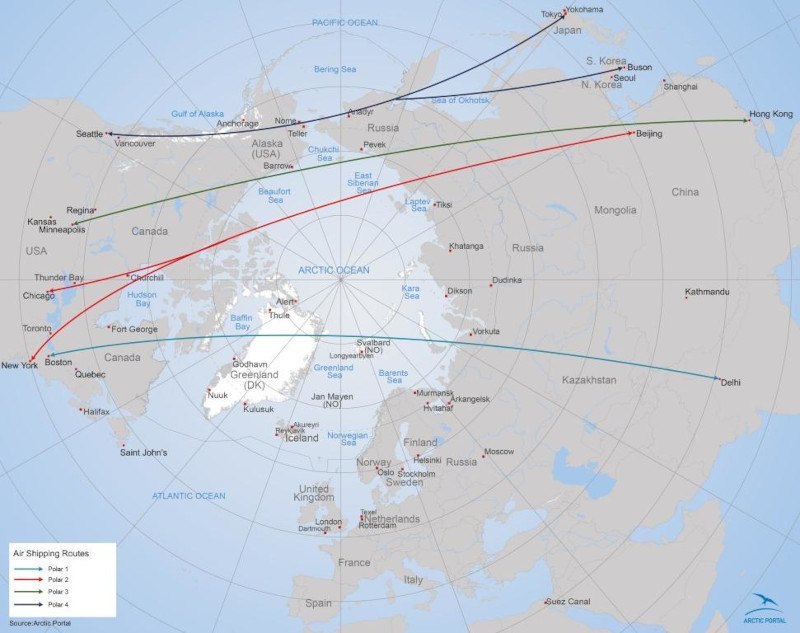
Trans-Arctic air routes have emerged as some of the fastest and most fuel-efficient paths between North America and Asia. By flying directly across the uninhabited Arctic ice cap, commercial aircraft reduce fuel consumption, flight time, and carbon emissions, making these routes increasingly attractive from both economic and environmental standpoints.
Defining the Polar Route
The term "Polar Route" originated in the mid-20th century to describe flight paths that pass north of 78 degrees latitude, across the high Arctic region. These routes encompass areas over northern Alaska, Siberia, and beyond the Ural Mountains. They became fully viable for commercial aviation in the late 1990s, when Russia opened its Arctic airspace to international traffic.
The ICAO officially recognizes four major Cross-Polar Routes:
- Polar One
- Polar Two
- Polar Three
- Polar Four
These routes form the backbone of transpolar aviation, allowing non-stop service between major international hubs.
Milestone Flights and Route Adoption
The first demonstration flight through Siberia was conducted by Cathay Pacific in 1998, flying from Hong Kong International Airport into Russian airspace. This successful operation marked a turning point in polar aviation.
Since then, leading international carriers—including United Airlines, Air Canada, Lufthansa, and Air China—have increasingly adopted these routes for long-haul travel between North America and Southeast Asia. The ability to fly non-stop between high-demand city pairs has led to widespread commercial interest.
Strategic Hub Airports and Route Operations
The Arctic and sub-Arctic regions now host several strategically located hub airports that support Polar Route operations. In Siberia, key facilities include:
- Novosibirsk Tolmachevo Airport – A major hub for Polar One
- Krasnoyarsk Yemelyanovo Airport – Supports Polar One operations
- Irkutsk International Airport – Primary for Polar Two
- Yakutsk Airport – Serves both Polar Three and Four
These airports feature runways exceeding 3,000 meters, capable of accommodating large aircraft such as the Boeing 747-8, Airbus A350, and other long-range wide-body jets.
Infrastructure Development and Modernization
In response to the growing demand for polar air traffic, governments and airport authorities in Russia, China, Canada, and the U.S. have invested heavily in infrastructure upgrades, including:
- Runway expansions
- Cold-weather operations capability
- Enhanced air traffic control systems
- Improved satellite communication for remote Arctic regions
International organizations such as ICAO and the International Air Transport Association (IATA) continue to collaborate with Arctic nations to ensure safety, efficiency, and environmental sustainability in polar operations.
Environmental and Strategic Significance
In addition to reducing fuel use and flight times, polar routes contribute to lower carbon emissions, aligning with the climate goals of many Arctic and non-Arctic nations. However, the increased traffic also raises concerns about the environmental impact on fragile Arctic ecosystems and the need for emergency preparedness in remote, uninhabited areas.
As air traffic over the Arctic is projected to double by 2030, continued coordination between nations and modernization of polar aviation protocols will be essential to manage growth responsibly.
To see the main Arctic port of entries, please visit our Arctic Data Management System (ADMS).
Source: Isavia International Civil Aviation Organization Map: Arctic Portal (to view more maps please visit our Map Gallery)
- Details
- Written by: ofurpaur
- Category: Shipping
- Hits: 2875
As globalization and human activity in the Arctic continue to expand—including increasing commercial air traffic—there is a growing need for coherent legal frameworks that ensure safety, cooperation, and environmental protection. The unique geopolitical and environmental characteristics of the region demand a blend of international aviation law and domestic regulations specific to each Arctic state.
The Dual Nature of Arctic Aviation Law
Arctic aviation law operates at the intersection of international and national legal systems:
- International Law governs aspects such as aircraft certification, airspace use, safety standards, and the rights of passengers and cargo in transit.
- Domestic Law regulates the business operations of airlines, airport management, and infrastructure development, with each Arctic state—such as Canada, the United States, Norway, and Russia—implementing its own rules in line with international agreements.
Core Elements of the International Aviation Legal Framework
The international legal framework governing Arctic aviation consists primarily of treaties and conventions to which Arctic states are parties. These include:
- Aircraft registration and safety standards
- Transit and overflight rights
- Passenger and cargo liability
- Environmental compliance and climate obligations
These legal instruments can be either:
- Self-executing, requiring no additional national legislation to take effect, or
- Non-self-executing, meaning they must be formally adopted into national law.
Key Institutions and Regulatory Bodies
International Civil Aviation Organization (ICAO)
A specialized agency of the United Nations, ICAO plays a central role in shaping global aviation law. It develops international standards and recommended practices (SARPs), mediates disputes, and facilitates coordination between member states.
European Union Aviation Safety Agency (EASA)
Established in 2002, EASA replaced the Joint Aviation Authorities and is responsible for:
- Certifying aircraft and aviation products in Europe
- Ensuring compliance with safety and environmental standards
- Supporting Arctic EU member states in harmonizing aviation regulations
Important Treaties and Conventions can be viewed and accessed in our database:
- Paris Convention (1919) – Regulation of aerial navigation
- Chicago Convention (1944) – Foundation of modern international civil aviation law and ICAO
- International Air Services Transit Agreement – Transit rights over territories of member states
- International Air Transport Agreement – Commercial aviation and route access
- Agreement on Trade in Civil Aircraft – Facilitates tariff-free trade in aircraft
- General Agreement on Tariffs and Trade (GATT)
- General Agreement on Trade in Services(GATS) – Covers air transport services in trade law
- Warsaw Convention (1929) – Rules relating to international carriage by air (passenger liability)
- Montreal Convention (1999) – Update to the Warsaw Convention, improving passenger protection and simplifying liability rules
Recent Developments and Ongoing Challenges
With the rise in Arctic aviation traffic, several pressing issues have gained attention:
- Environmental concerns, such as black carbon emissions and climate impact on fragile Arctic ecosystems
- Search and rescue (SAR) cooperation and infrastructure gaps in remote polar areas
- Use of satellite navigation and communication systems to maintain safe air corridors
- Overflight rights and sovereignty concerns, especially as geopolitical interest in the Arctic grows
Additionally, newer agreements and regional initiatives—such as updates to ICAO’s Polar Operations Guidance—are increasingly important for ensuring resilience, safety, and sustainability in Arctic airspace.