
- Details
- Written by: ofurpaur
- Category: Shipping
- Hits: 40222

The Northwest Passage is first and foremost considered to be continuous passage between islands and the continental mainland of Canada rather than an actual shipping route.
Historical Perspectives
Historically the Northwest Passage is known as Strait of Anian, which is a Spanish name for the passage that in 16th century was believed to connect the Pacific Ocean with the North Atlantic, which back then was the most desired shipping route of commerce.
Geography and Navigation
The Passage represents a potentially attractive and valuable commercial shipping route if it were to become more accessible for navigation at a longer period of the year. In reality, it is a series of passages through straits of the Arctic Archipelago. It allows shipping from the North Atlantic Ocean, up Davis Strait between Canada and Greenland. The passage then continues through the Arctic Archipelago, to the Beaufort Sea over to Chukchi Sea and the Bering Strait into the North Pacific. Because of the many islands of the Arctic Archipelago, the potential shipping routes are in fact several each way. However some straits are more feasible than others due to the formation of the land under water.
Legal Disputes and Sovereignty
The question arises with regards to the Northwest Passage and delimitation of Beaufort Sea. By virtue of the historical title and state´s location on the landward side of the baselines drawn around the Arctic Archipelago in 1985, Canada claims Northwest Passage as its internal waters while the United States government argues the Northwest Passage to be an international strait as it connects to bodies that is Davis Strait and Baffin Bay and it is used for international traffic.
The Canadian argument states that Northwest Passage has not been explored internationally while the US brings up the climate change issue, causing the opening of the Arctic waters and the future plan for the Passage to become one of the main Arctic international shipping routes.
Current Use and Bilateral Cooperation
Currently, the Northwest Passage is being the shortest and most direct way for United States´ eastern regions to ship to Alaska. Both states decided to give them control over the Northwest Passage to monitor the route and ensure compliance with international legal standards for security and freedom of navigation.
Strategic Importance and Development Potential
As with the Arctic itself, the status of the Northwest Passage was given limited attention until the latter part of the 20th century. The reason for that, as with other ice-covered areas of the Arctic, is that no particular interest was shown to utilize the route for transport and the conditions were thought to be dangerous. The tables have certainly turned.
While oil and gas development in the Arctic is touched on, use of the Northwest Passage as a supply and service route to and from Asia is a big part of the future Arctic´s plan. New business opportunities, connected not only to the Arctic´s oil and gas resources but also the iron ore, diamonds, gold and fisheries, encourage investors from key business sectors to improve technology in order to develop better and more sufficient infrastructure in the northern hemisphere. Deepwater ports, road infrastructure, greater search and rescue presence and increased graduation rate among Inuit youth in order to increase the growth of northern workforce, are the key objectives for scientists and policy makers to be taken into account.
The Global Outlook
Nowadays the Northwest Passage is seen as a revolutionary opening for large scale transportation by ships from the North Pacific to the North Atlantic Ocean. Despite the dispute between United States and Canada, Northwest Passage is seen as a global issue to affect trans-Arctic shipping operations of many countries. It is predicted that in near future, it will provide an impetus for international commercial usage.
Visualizing the Future
The Arctic Data Management System provides visualization of Arctic Shipping Routes. Please, click the link under the box on the right hand side to access the map or view the map of the Northwest Passage.
Source: Breaking the Ice: Arctic Development and Maritime Transportation Map: Arctic Portal (to view more maps please visit our Map Gallery)
- Details
- Written by: ofurpaur
- Category: Shipping
- Hits: 38724
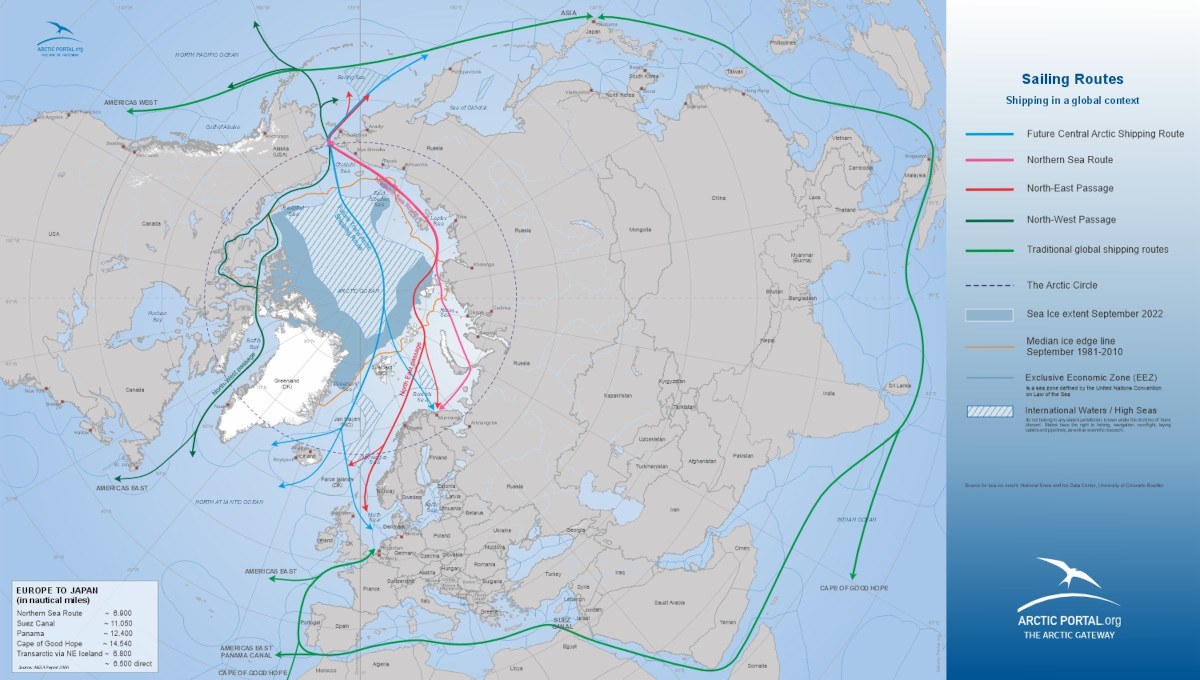
Global climate change and melting sea ice, offers more and more opportunities for international transportation networks.
Notably, the trend of receding ice caps around the North Pole could possibly make the Arctic more reliable for scheduled navigation, at least during the summer months.
The Northwest Passage and the Trans-Arctic Shipping Route
The Northwest Passage, crossing the Canadian Arctic, is predicted to be used on a regular basis in the near future, cutting down the maritime shipping distance from East Asia and Western Europe substantially.
Currently, two sea routes have been defined to cross the Arctic, enabling ships to move between the Atlantic Ocean and the Pacific Ocean and thus have the possible status as an international strait (or waters) giving right to transit passage.
Both of them overlap significantly with the jurisdiction of either Canada or Russia, which can create certain legal difficulties if or when Trans-Arctic shipping becomes a reality.
Scientific data, to what extent the receding perennial ice cover is melting remains highly uncertain. Cargo shipping services around the Arctic Circle are very limited, as there is no possibility for the operators to drop off and pick up cargo as they pass through. This also limits the opportunity for the trans – shipment hubs to rise along the Arctic shipping routes.
The Arctic Shipping Routes
In the shipping portlet, more information can be found on the Northwest Sea Route and the Northeast Sea Route, as well as the more distant possibility of the Central Arctic shipping route.
Click on the map above to view the current and future Arctic shipping routes. You can also access the Arctic Portal Arctic Data Management System and find Arctic shipping routes under Arctic Shipping in the drop-down menu on the left-hand side.
Source: National Snow and Ice Data Center (NSIDC) Map: Arctic Portal (to view more maps please visit our Map Gallery)
- Details
- Written by: ofurpaur
- Category: Shipping
- Hits: 8495
The Arctic contains some of the last physically undisturbed areas on the planet, something that is becoming very rare in modern times. In recent decades, and especially during this millennium, the Arctic has also been undergoing extraordinary environmental changes. The Arctic is known as a storehouse of massive supplies of natural resources, which is increasing pressure on their extraction due to high commodity prices and a growing worldwide demand for them.
Marine Activity and Its Emerging Impacts
Increasing regional and coastal marine transport to support the exploration and extraction of oil, gas, and hard minerals, coupled with the increasing presence of the global marine tourism industry, can bring various users to the maritime Arctic. The potential impacts of these new marine uses can become significant. However, speculative they might seem, social, environmental, cultural, and economic impacts will become a reality, and have, to a certain extent.
Environmental Risks of Commercial Shipping
The environmental consequences of increased commercial shipping in the Arctic could become quite serious, not only from accidental oil spills, but also from increased pollution caused by operational discharges of oils and chemicals. Arctic ecosystems can be affected by pollution, noise, alien species, ships colliding with marine mammals, and general disturbance, including loss of feeding and breeding areas.
Problems can be caused by ships involved in oil and gas exploration and exploitation, including tankers, as well as by general cargo vessels, naval vessels, fishing vessels, tourist cruise ships, and even scientific research vessels.
Long-Term Pollution and Ecosystem Health
Despite the seriousness of rare catastrophic oil spills, chronic low-level pollution over many years from all kinds of ships poses the greatest threat to the environment and may affect all ecosystems within a given area.
Bioaccumulation and Food Chain Contamination
Contaminants accumulate in the body fat of Arctic organisms because they have evolved to store food for use in their bodies when none is available in the frozen environment. These contaminants are then passed up through the food chain, even to human beings.
Risks of Shipping Accidents
Increased shipping activity in the Arctic raises the potential for increased numbers of shipping accidents with the detrimental human and environmental effects that might follow.
Prevention of marine accidents and actions designed to strengthen the effectiveness of preventive measures can be critical for Arctic marine shipping, given the difficulties of responding once an incident has occurred. Preventive measures include ensuring that vessels operating in the Arctic meet appropriate design, construction, and equipment standards; that vessel personnel have the specialized skills needed for operating in Arctic conditions.
Challenges of Emergency Response in Arctic Conditions
Emergency response is particularly challenging in the Arctic for a variety of reasons, including the remoteness and great distances that are often involved in responding. Additionally, the impacts of cold, ice, and a harsh operating environment on response personnel and equipment, and the lack of coastal infrastructure and communications to support and sustain a response of any significant magnitude, are immense.
Gaps in International Maritime Safety Standards
International conventions relating to ship construction, crewing standards, and other aspects of maritime safety apply in all ocean areas for vessels that are flagged in States that are parties to the conventions. However, these standards are not necessarily adequate for ships operating in the environmentally fragile, dangerous, and remote polar waters.
The Surge in Arctic Tourism
Tourism has increased dramatically in the Arctic because of increased awareness of its beauty and undisturbed nature, and also because of a desire to see it before the ice melts and the animals disappear.
However, excessive tourism could cause environmental damage, both from the usual problems caused by an increasing number of vessels and because waste from garbage and sewage would have to be disposed of.
Lingering Ice Hazards Despite Climate Change
If all the new single-year sea ice melts, navigation in the Arctic could remain hazardous for some time to come, as multi-year ice will linger, and so will icebergs, in particular those calving off melting glaciers.
This could result in more accidents, causing further problems, including pollution by leaking heavy fuel oil from cruise ships.
- Details
- Written by: ofurpaur
- Category: Shipping
- Hits: 4302
It is safe to say that the Arctic is one of the most fossil fuel-laden areas in the world, even though massive exploitation has still not begun. Other non-renewable resources are also immense the Arctic being rich e.g. of nickel, diamonds and gold.
Fossi Fuel Development and Arctic Shipping
However, the exploitation of fossil fuels is very dependent on Arctic marine shipping and is likely to be one of the main driving forces for Trans-Arctic shipping becoming a norm in the international trade industry.
National Strategies and Regional Development
Some regions, which have experienced major prosperity, some of it quite recently, have literally been opened to massive exploitation in support of national policies for industrial development or energy security.
For example Norway has clearly indicated its willingness and ambition for long term development of the oil and gas reserves found in Norwegian continental shelf.
Current Production and Future Potential
Most of the regions in the Arctic have both onshore and offshore production and exploration of a variety of non-renewables. The Arctic holds a great share of the world’s oil, coal and gas reserves. At the present, the Arctic produces about 10 percent of the world’s oil and a quarter of its gas and for these critical commodities the region’s role is estimated to be greater in the future.
Drivers of Increased Extraction
Increased activity in the field of extraction of non-renewable resources is expected not only from climate change-related factors, such as increased access caused by receding sea ice, but also from changes such as improvements in offshore technology, oil-price development, and the political landscape in the Arctic.
Economic and Technological Challenges
The International Energy Agency has estimated that the cost of petroleum extraction in the Arctic is about three times higher than in other petroleum provinces.
Sources: Arctic Marine Shipping Assessment
- Details
- Written by: ofurpaur
- Category: Shipping
- Hits: 3983
Climate change continues to have profound impacts globally, with the Arctic region experiencing some of the most significant and visible effects. The Arctic's average temperature has risen at a rate nearly four times the global average, making it the fastest-warming region on Earth .
 Arctic Sea Ice Decline
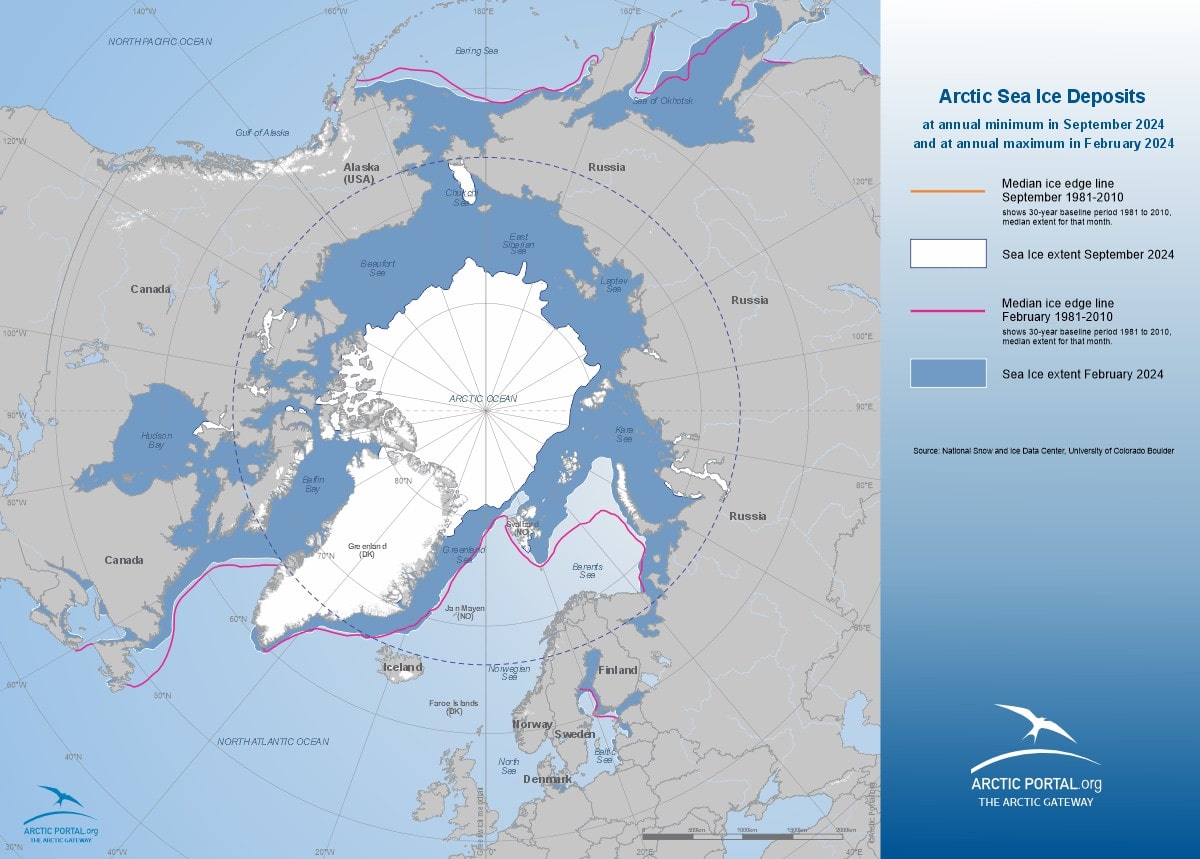
The extent of Arctic sea ice has been decreasing steadily. On September 11, 2024, the Arctic sea ice reached its annual minimum extent, measuring approximately 4.28 million square kilometers (1.65 million square miles). This marks the seventh-lowest extent recorded since satellite observations began in 1979 . The reduction in sea ice not only signifies a warming climate but also has cascading effects on global weather patterns and sea levels.
Implications for Shipping
The diminishing sea ice has opened new maritime routes in the Arctic, notably the Northern Sea Route. These routes offer shorter passages between Asia and Europe compared to traditional routes like the Suez or Panama Canals. However, increased shipping activity poses environmental risks, including potential oil spills and disturbances to marine ecosystems . Moreover, the infrastructure to support such routes is still developing, and the unpredictable nature of ice conditions presents navigational challenges.
Oil and Gas Exploration
Reduced sea ice has made previously inaccessible areas available for oil and gas exploration. Arctic oil and gas extraction are projected to increase by 20% over the next five years. While this presents economic opportunities, it also raises concerns about environmental degradation, especially given the fragile nature of Arctic ecosystems and the potential for oil spills in remote areas where response capabilities are limited.
However, the harsh and unpredictable conditions pose significant challenges. Extreme cold, shifting ice, and long periods of darkness complicate exploration, infrastructure development, and emergency response. Additionally, operating in such a remote region leads to higher costs and greater environmental risks, requiring specialized technology and international regulatory coordination.
Ecosystem Changes
The Arctic ecosystem is undergoing rapid transformations. Thawing permafrost has turned the tundra from a carbon sink into a carbon source, releasing significant amounts of greenhouse gases into the atmosphere . Wildlife populations, such as polar bears and caribou, are declining due to habitat loss and changing food availability . These changes not only affect biodiversity but also the Indigenous communities that rely on these species for subsistence.
International Climate Agreements
Efforts to address climate change continue on the international stage. The 2024 UN Climate Conference (COP29) emphasized the urgency of limiting global temperature rise to 1.5°C. Achieving this goal requires immediate and transformative actions, including significant reductions in greenhouse gas emissions . The Arctic's rapid changes underscore the importance of global cooperation in mitigating climate impacts.