
- Details
- Written by: ofurpaur
- Category: Shipping
- Hits: 18742
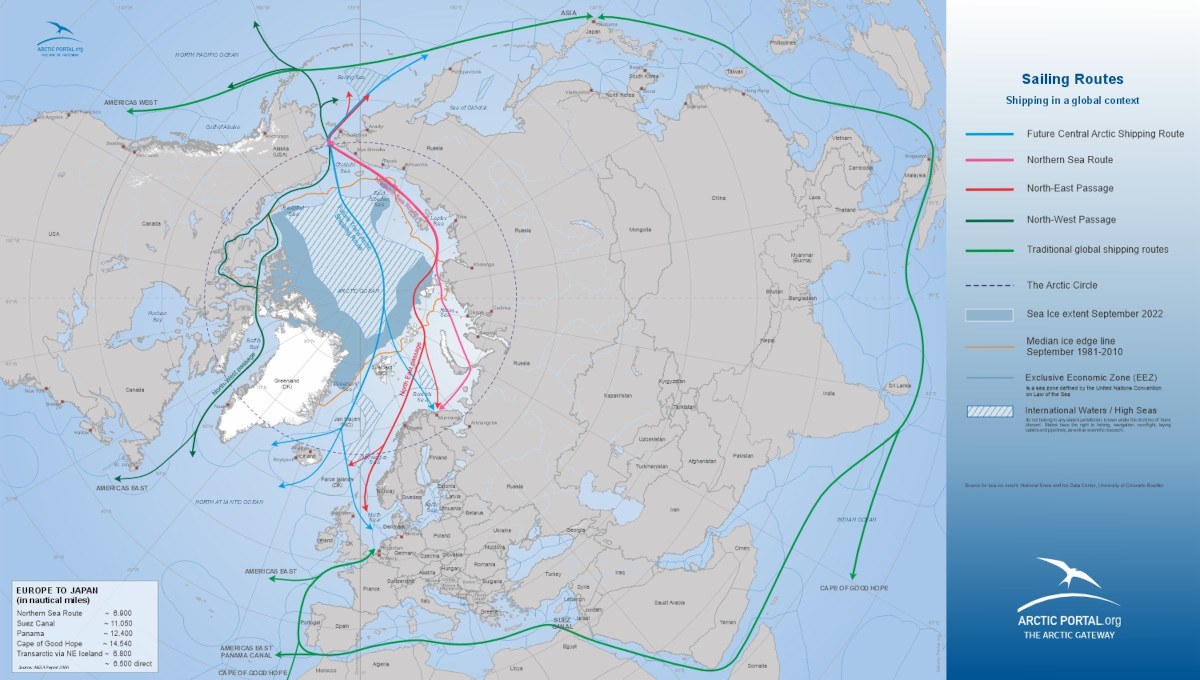
The future of Arctic Shipping – Is there a business case? Who will drive it? Science, technology, infrastructure, the actors!
Halldór Jóhannsson, Arctic Portal, Iceland
Currently, there are limited developments supporting increased shipping activity through the Arctic, at least by small to medium-sized business operators. For Arctic shipping to increase, it needs a driver. How and by whom will its development be led, and how will it be utilized twenty years from now?
A very strong consensus among those attending the ACI shipping conference in Hamburg in December 2018 was that there would be caution and likely much less activity in shipping through the Arctic than previously predicted, at least by small to medium commercial shipping operators. The cost, complications, and potential risk are simply too high, and the return and advantage are too small for them to become interested. The concerns of the stakeholders are a clear lack of infrastructure and information services, but more that the business case is not there, or at best, is unclear. As domestic shipping, fishing, and tourism is, however, expected to increase, there were strong concerns of limited search and rescue infrastructure and training. The question “Who is responsible for organizing safe and prosperous utilization and paying for needed further developments?” was also widely discussed, but neither the shipping nor the insurance companies currently see a clear role here for them to play. The questions and concerns are if anything more relevant now in 2023, given the more complex Geopolitics and constraints in international collaboration in science, business, and policymaking!
The business of shipping in the Arctic will need to develop in a global context. It will therefore have to be an international undertaking. There is a clear and highly important need for ongoing internationally driven research and improved integrated observations, new information services, clear regulations, and infrastructure development in the Arctic region, not least related to search and rescue services.
The Russian Yamal LNG project is a case study and an immediate test of the viability of Arctic Sea routes and their potential role as the blue economic corridor. Future activities will likely be driven by the largest international companies, likely with direct mandate and support from governmental bodies, that then can approach the business of Arctic Shipping from an economic, political, and global agenda.
The uncertainty surrounding the Arctic Council and its future development certainly complicates the situation immensely. This section on Arctic Shipping by the Arctic Portal will be updated regularly with information and data, in collaboration with leading experts and organizations, in the spirit of open science for the benefit of all!
- Details
- Written by: ofurpaur
- Category: Shipping
- Hits: 2506
The Arctic´s infrastructure is currently strained to the state of limited functionality. Increased number of passengers travelling to and through the Arctic and still depleting funds have caused Arctic´s states governments to become concerned with the future of the Arctic´s sea ports and airports infrastructure.
The Arctic Portal Shipping Portlet recognizes the intermodal nature of infrastructure challenges in the Arctic and the unique needs, challenges and opportunities for sustainable development of the Arctic´s marine and air transportation.
The Shipping Portlet is envisioned as multiyear task to take place within the Arctic Portal project. It establishes the hub for data sharing and analysis which are being used by various stakeholders, including international organizations, educational institutions, private and state – owned commercial companies and businesses as well as private individuals.
The Shipping Portlet will gather baseline data from project partners to include the Arctic ports and airports capabilities, search and rescue assents and icebreakers ´capacity. Additionally, the Shipping Portlet will provide complete information with regards to regulatory and policy issues of the Arctic states regarding maritime and air transportation, cargo and passengers vessels and airships development. It will highlight the unique features of northern air and sea operations and its environment, the need of funding for sustainable airship development and deployment through the Arctic.
The cooperation with the prospect partners will include the contribution to the project deliverables to include data reports, studies and publications, the suggestions of new ideas that could improve the project goals, participation in surveys and validation activities. Prospect partners would be asked to contribute to the promotion of the outcomes of the Arctic Portal Shipping Portlet by linking the project website with relevant internet page, in order to rise public awareness with regards to the Arctic marine and aviation challenges and to provide with sufficient funding for the project continues development.
For more information or to contribute to the Arctic Portal Shipping Portlet, please contact Halldór Jóhannsson at
- Details
- Written by: ofurpaur
- Category: Shipping
- Hits: 2712
Arctic Marine and Aviation Transportation Infrastructure Initiative is the Project co-led by the United States and Iceland, under the guidance of the Arctic Council's Sustainable Development Working Group. The principal Investigator is the Institute of the North located in Anchorage, Alaska, USA
Increased resource extraction to support economic and community development and increased shipping traffic through Arctic waters have resulted in the corresponding need for an increased capacity to respond by sea and air.
Arctic ports and airports serve as an important base for response, acting as a gateway to support SAR, resource extraction and development activities, pollution prevention and environmental safety, and community health and security.
The Arctic Council's Sustainable Development Working Group approved a project during the Swedish Chairmanship (co-led by the United States and Iceland) to assess transportation infrastructure. The Arctic Marine and Aviation Transportation Infrastructure Initiative (AMATII) seek to evaluate Northern infrastructure – ports, airports, and response capability – by inventorying maritime and aviation assets in the Arctic.
The Project aims to create:
- An Arctic Maritime and Aviation Infrastructure Database, a web-based, searchable map that builds in layers of baseline data, including infrastructure, connectivity, weather, navigational aids and communications data, and traffic.
- A Port and Airport Infrastructure Conference that invites international stakeholders to consider infrastructure extent and best practices, within the context of sustainable development.
- A Guidance Document with case studies and illustrative stories of northern aviation and marine infrastructure to highlight the challenges of infrastructure development in the Arctic and its role in facilitating sustainable development.
For more information, please access the AMATII homepage. AMATII Database.
- Details
- Written by: ofurpaur
- Category: Shipping
- Hits: 2490
The Arctic Region brings together some of the top strategies, technical consultants and international investments from North America, Asia and Europe.
The Arctic Portal was created in 2006 to endorse the legacy of International Polar Year (IPY), supported by the Arctic Council under the guidance of Iceland´s Senior Arctic Official – Ragnar Baldursson.
The Project is managed as a non – profit organization in cooperation with the University of Akureyri (Iceland). Up to date, the Arctic Portal hosts the official homepage of IPY International Program Office and will serve as an interface to and host of IPY Legacy research data.
In addition of being a unique information gateway and the main IPY platform, the Arctic Portal hosts the homepages of main Arctic science related organizations as well as participates in various Arctic cooperation programs.
The Arctic Portal Shipping Portlet is a comprehensive online gateway to the Arctic Shipping and Aviation. It outlines the most topical maritime and aviation issues, including benchmarking and baseline assessment of sea ports and airports infrastructure, and provides an overview of the latest news, events and publications on Arctic transportation.
Its objective is to increase information sharing and interoperability between stakeholders throughout the Arctic and grant exposure to the Arctic related shipping data. It aims to establish a network connection between public and private sectors to raise public awareness with regards to environmental, legal and political issues of Arctic Shipping.
The Arctic Portal Shipping Project was launched in 2010 as an endorsement to the Arctic Portal information gateway. In past two years, the Shipping Portlet has become valuable source of information on the major changes that have been taking place in the Arctic Region. The melting Arctic sea ice will enable unforeseen industrial and business opportunities, but in the same time it will threat fragile Arctic environment and coastal communities. The immense changes that the Arctic is facing will affect the political as well as economical decision making processes requiring easily accessible or high quality information.
Please, contact us if you have any queries with regards to possible cooperation, partnership or copy rights issues. Halldór Jóhannsson: e mail:
- Details
- Written by: ofurpaur
- Category: Shipping
- Hits: 3374
The Arctic is comprised of a large ocean area and land areas of eight states: Canada, Denmark (Greenland), Norway, Russia, USA (Alaska), Finland, Sweden and Iceland. The Arctic's most pronounced feature, at least until very recently, has been the large ice-covered ocean. However, significant changes are taking place in the Arctic Region, both on land and especially on the maritime areas.
The 2004 Arctic Climate Impact Assessment listed the range of impacts that are occurring in a warming Arctic due to the human-influenced climatic change. The report concluded that the air temperature has risen at twice the rate as in the rest of the world in the past few decades and there is increasing evidence of widespread melting of glaciers, permafrost and sea ice.
The Arctic Region has been under ongoing transformation. Unprecedented and disruptive changes seem to occur more rapidly than anywhere else in the world. Increasing average temperatures cause the rise of the sea level and changes to seasonal length.
Scientists and researchers from various international and national institutions have tried to predict the date when the Arctic Ocean will become free of sea ice during summers. As suggested by IPCC report, this might occur by the end of 21st century.
In April 2012 Lloyds, which is the leading insurance market specialist, conducting business in over 200 countries and territories worldwide, presented the report on risks and opportunities in the High North, where the issue of sustainable development was strongly highlighted.
Over the last decade, Northern Sea Route (NSR) has already started to see the increase of summer cruise traffic, mostly by Russian - owned vessels. However the other activities, from international tourism to scientific research, also present the potential increase in the coming years.
As the new Lloyds´ Arctic report states, the infrastructure to support investments in Northern Region is very limited. That could cause a great risk to the Arctic unspoiled environment with a complex and very fragile ecosystems. It is suggested that in terms of accidences occurrence, such as an oil spills or blowouts, the consequences for the delicate environment could be more profound than in other world´s regions.
As estimated by Lloyds, the future investment in the NSR development could go up to 10 million dollars. Growing interest in four key sectors including mineral resource, fisheries, logistics (especially Arctic shipping) and tourism will prove to be significant dimensions in economic development. As predicted by the authors of the report, the epicenter for those investments will reach the area of Barents Sea, northern Russia, Norway, Alaska and eastern Iceland.
Already, summer shipping season along the NSR is marked by a new development. In the summer of 2011, the Russian-owned Vladimir Tikhonov was noted as the first supertanker to sail through the NSR with loaded cargo exceeding 120,000 tones of gas condensate. In the same time Japanese – owned Sanko Odyssey, with the load of cargo exceeding 66,000 tons of iron ore concentrate, did complete a voyage from northern Russia to Jingtang in China.
Summer 2012 is very likely to bring the opportunity for the Korean built and Norwegian – owned tanker, Ribera del Duero Knutsen, to become the first LNG carrier to transit the Northern Sea Route from northern part of Norway to Japan.
Those indicators show significant interest from the Asian states in the Arctic Region. In May 2012 governments of South Korea and Norway came together to discuss the possibility of future partnership and mutual interest in developing high class infrastructure, including coastguards, search and rescue and hydrographic services for the future traffic increase.
As the potential oil and gas resources around the Norwegian coast are more predictable, the government expects the Snohvit gas field and the Goliat oil field to attract investments which might reach 9.2bn$.
As the sailing season extends, shipping companies will face the reduced cost of marine operations as distances between ports in Western Europe and Japan, eastern Russia and north – eastern China or Korea Peninsula, are almost 40 % shorter through the NSR than traditional passage over the Indian Ocean, Red Sea and the Suez Canal.
Commercial development in the Arctic will truly touch oil and gas reserves around Russian and Norwegian Arctic coast. It is estimated that there is a potential of 845 million m3 hydrocarbon resources in the North Sea, 780 million m3 in the Norwegian Sea and almost 950 million m3 in the Barents Sea around Russian North and Svalbard.
However, there are still commercial rationales and risks involved in the decision making process as of the geological uncertainties in the Arctic Region. Proven reserves would secure the companies´ financial plans and allow the sooner exploitation.
Expectation to keep the price of oil in the 80$ - 120$ range requires lowering the cost of production which leads to infrastructure development. It is however expected that other Arctic developments, such as offshore Greenland, with the high production cost, would require major investment in order to stay profitable. To date, Cairn Energy is the only company undertaking exploration in the Greenland Sea. The registered investment of over 1bn $ has not brought a major success. Greenland´s state – owned company, Nunaoil has shown the interest in the investment worth over 10bn$ in West Disko and in the Baffin Bay. Both plans are due in 2040.
International Energy Agency predicts that the total investments in the oil and gas sector would reach 20,000bn$ between 2012 and 2038. Russia´s great contribution of overall investment, going up to 50bn$ has been made by the Shtokman, far largest potential offshore Arctic project. In oil, TNK-BP plans to spend up to 10bn$ on developing onshore Arctic oilfields in the Yamal – Nenets Autonomous Area, with exports to Asia from 2015 – 2016.
Canada and United States also renewed their interests in the Arctic. Shell, ConocoPhillips, Statoil, Repsol and Eni won exploration leases for the Beaufort and Chukchi Seas in 2008, paying out a total of 2.66bn$.
There are many reasons for shipping and drilling companies to put their interests in the Arctic. Northern hemisphere has been much less geologically explored than other regions in the world. It logically gives a chance to discover the world class deposits. However the challenges and drawbacks are almost as many as opportunities. Remoteness, lack of infrastructure and difficult weather conditions which can disturb the production schedules are current logistical bottlenecks.
Source: Arctic Opening: Opportunity and Risk in the High North