
- Details
- Written by: ofurpaur
- Category: Shipping
- Hits: 3837
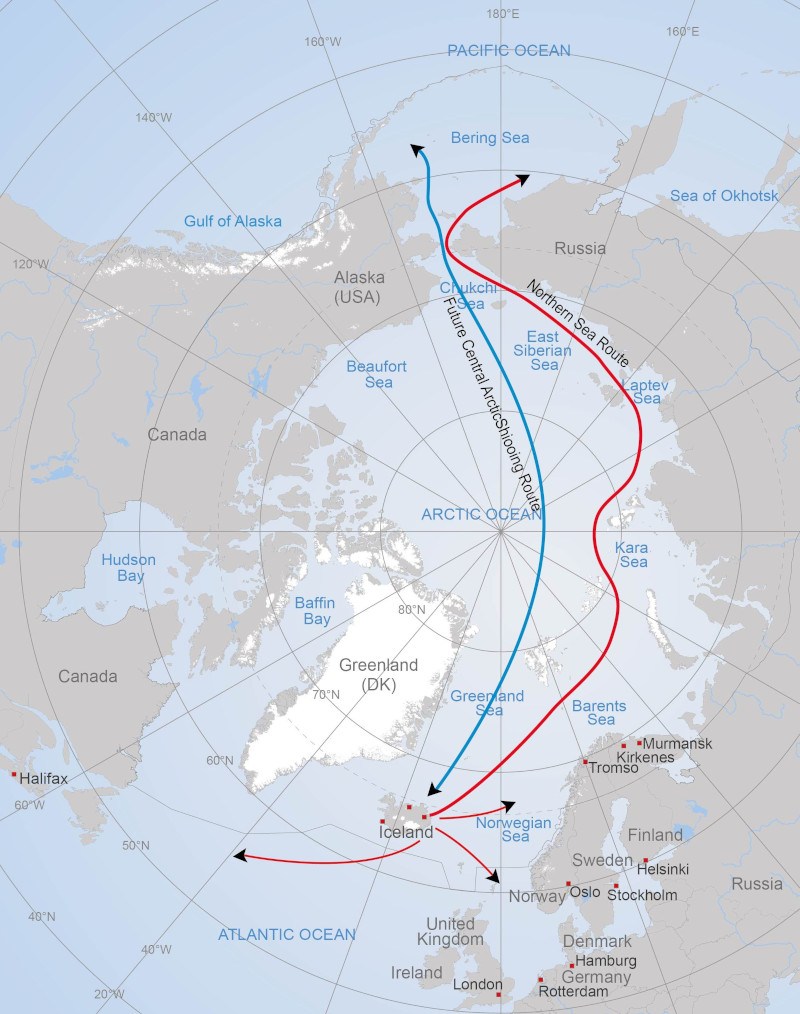
The East Coast of Iceland, positioned at both the gateway to and exit from the Arctic Ocean, is gaining increasing attention from Arctic nations. Its geographic position makes it a prime candidate for trans-shipment operations in the North Atlantic, offering a strategic opportunity to shorten shipping routes for ice-class vessels.
As Arctic shipping becomes more financially viable, especially due to diminishing sea ice, vessels with ice-class certification no longer need to travel long distances, reducing operational costs and emissions.
Potential for a Major Trans-Arctic Hub
A hub port on Iceland’s East Coast could become a highly competitive option for trans-Arctic logistics. According to shipping data, this location could potentially handle over 100,000 twenty-foot equivalent units (TEUs) annually—surpassing current capacity at the Port of Reykjavik.
To meet future demands, the port infrastructure must accommodate millions of containers per year, with berths up to 400 meters long and 20 meters deep. It must also be capable of servicing ultra-large vessels up to 430 meters in length, 58 meters wide, and with a draught of 16.5 meters.
Environmental and Operational Challenges
Despite the strategic advantages, the Icelandic coastline presents several challenges. The East Coast is frequently affected by heavy fog, high swells, and severe winds reaching up to 80 meters per second. These conditions complicate port operations, especially the handling of large vessels and the use of cranes.
Harsh weather also poses difficulties for expanding infrastructure, such as constructing additional wharfs or extending hub facilities in the future.
Infrastructure and Supporting Resources
Iceland’s competitive advantages lie in its abundant and inexpensive renewable electricity and water resources—both essential for continuous trans-shipment operations. The proximity of nearby airports with frequent international flights enhances connectivity between marine and air transport.
Moreover, low-cost repair and maintenance services, along with access to oil storage for fleet needs, strengthen the case for developing a large-scale hub on the East Coast.
Investment Considerations and International Cooperation
While the estimated cost of the project—approximately €900 million—is substantial, it raises important questions about Iceland’s financial capacity to lead such a development. Nonetheless, international collaboration between Arctic governments and private investors could accelerate progress and distribute the financial burden.
Notably, countries like Russia and other major exporting nations have shown interest in supporting such an initiative, indicating a broader geopolitical and economic relevance beyond Iceland alone.
Sources: Dreki Area, North Meets North: Navigation and the Future of the Arctic, Northern Sea Route Project Map: Arctic Portal (to view more maps please visit our Map Gallery)
- Details
- Written by: ofurpaur
- Category: Shipping
- Hits: 5295
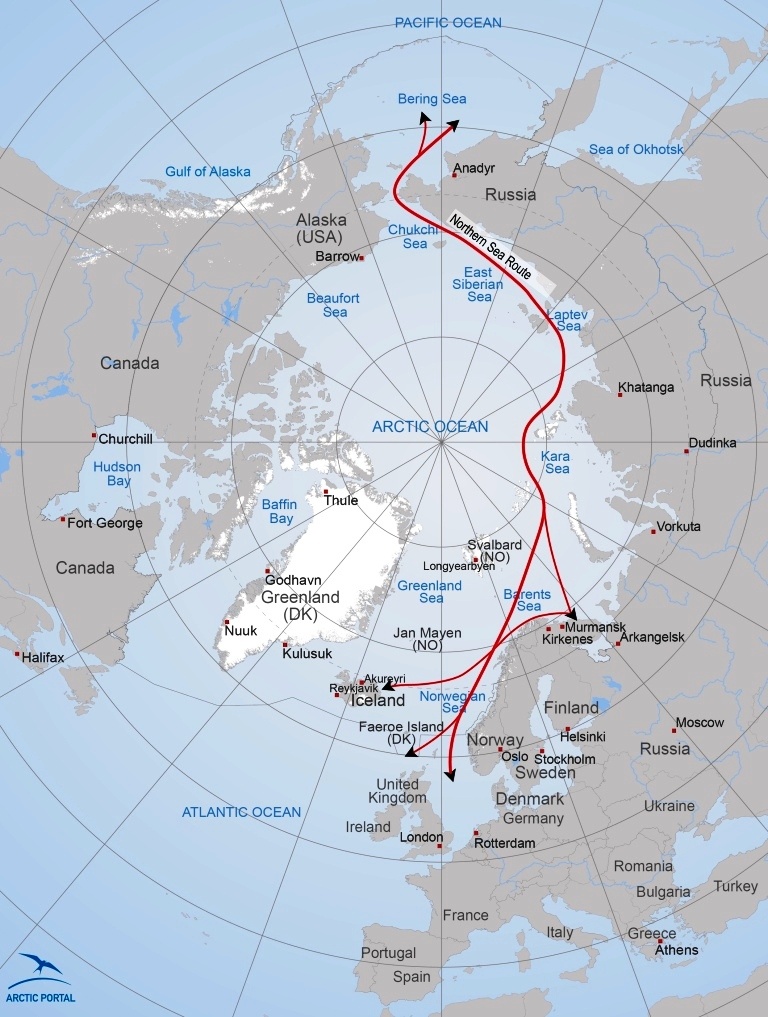 A warming climate is opening new opportunities for global transportation networks, particularly by reducing Arctic maritime navigation distances—at least during the summer months. The gradual opening of the Northern Sea Route (NSR) increases demand for new port facilities and modern infrastructure capable of servicing vessels navigating both ice-free and ice-covered waters.
As Arctic marine shipping becomes increasingly complex, a hierarchical network of shipping routes and ports is emerging. These evolving Arctic arteries are characterized by fewer ports of call, larger vessels, and the need for robust support infrastructure, particularly at strategically located hub ports.
The Role and Placement of Arctic Ports
Arctic shipping hubs are typically located near urban centers. This proximity provides access to labor for cargo handling operations and ensures that port activities align with economic centers. These ports are situated in highly accessible areas and maintain direct connections to key global cities, positioning them as crucial players in the development of the Arctic shipping industry.
Key Arctic Port Hubs and Their Development
Murmansk Oblast, Russia
Murmansk is currently the largest Arctic shipping hub, strategically positioned on the Kola Peninsula along the Barents Sea. As a non-freezing, deep-water port, it can accommodate all types of vessels year-round. Plans are underway for a major modernization of Murmansk as part of Russia’s strategy to expand industrial activities along Kola Bay. In addition to operating along the ice-free parts of the NSR, it is also capable of supporting operations along the Northwest Passage.
Petropavlovsk, Kamchatka
The port of Petropavlovsk is poised to become the eastern hub for the NSR. According to recent Russian government reports, this port will serve as a central node for all vessel traffic operating along the route, significantly boosting its international standing.
Singapore: The Asian Gateway to the Arctic
Singapore, located on the southern tip of the Malay Peninsula, is one of the world’s most important global hubs. It is connected to over 600 ports in 120 countries. The development of the NSR will enhance its importance as the main Asian entry point to the Arctic, transforming it into a vital node in Arctic-Asian trade.
Halifax, Canada
Located in Nova Scotia, Halifax is being positioned as the Canadian gateway to the Arctic. With the potential for Chinese imports to be transported via rail through Moscow to Murmansk and then across the Arctic Ocean, Halifax may emerge as a strategic entrance for Arctic shipping into North America.
Comparative Overview: Port Depth and Length
Research conducted by the Icelandic Maritime Administration highlights key comparisons between existing and emerging Arctic hubs:
- Depth: The transshipment harbor at Vopnafjörður, East Iceland, drops steeply to over 70 meters, exceeding the depths of most Arctic hub ports. Only Murmansk and Halifax are comparable in this regard.
- Length: A comparison of fairways, roads, berths, and terminals reveals no major differences between selected Arctic ports. However, Shanghai, despite being the shallowest among them, has a slightly greater overall port length.
Sailing Directions and Shipping Efficiency
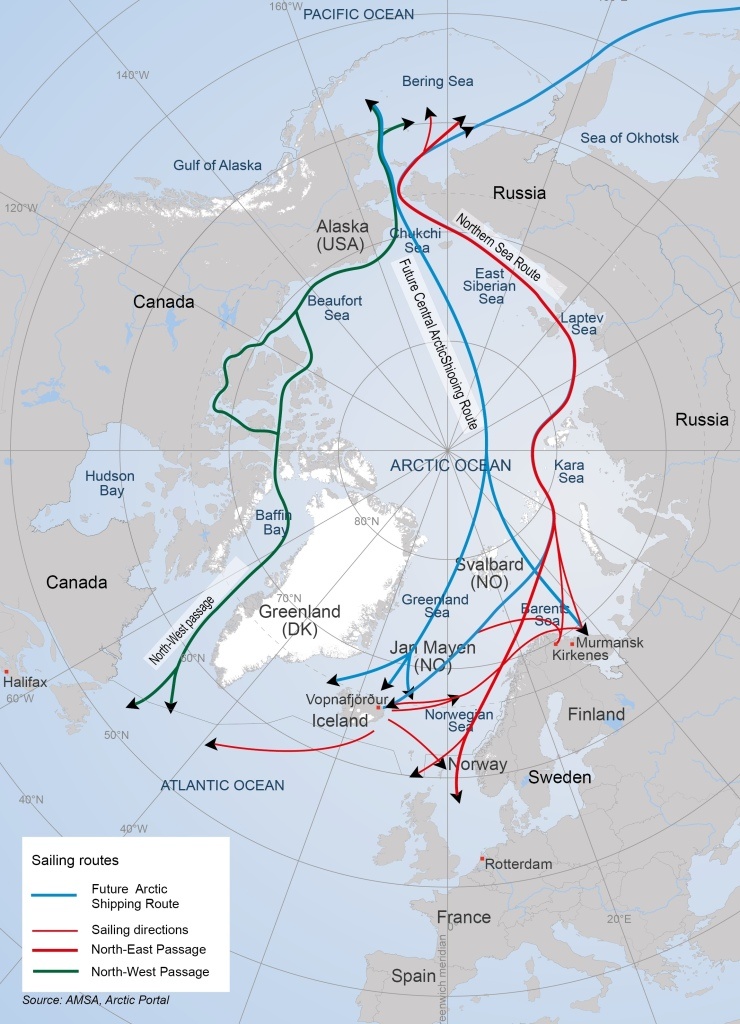
The development of a centralized Arctic network of transshipment hubs simplifies and integrates navigation and logistics across key locations. This centralization improves cost-efficiency and operational coordination for both public and private shipping companies (see map for better reference).
By shortening the distances between principal hubs and regional destinations:
a) Risks and operational errors are minimized
b) Security standards are enhanced
c) Transit times are cut by days, saving thousands of miles per voyage
These improvements are expected to reduce freight costs by over 20% for large container vessels. Larger ships stand to save even more, which in turn lowers the cost of trade and consumer goods in remote Arctic areas.
Strategic Cooperation and Regional Value
Three major Arctic hub ports—Murmansk, Kirkenes (Norway), and East Iceland—are capitalizing on their geographic advantage to form a framework for international Arctic marine cooperation.
Their greatest long-term value lies in their ability to support the NSR, once it becomes fully operational. However, their regional and local significance should not be overlooked, as they remain vital to smaller-scale Arctic economic and shipping activities.
Interactive Tools and Further Exploration
To explore more about Arctic ports:
- Refer to our interactive port database.
- Use the dropdown menu on the right-hand side to select a country of interest and view marine ports located within each Arctic state.
Please refer to the Arctic Data Management System to see the most important Arctic seaports. To see marine ports located in all Arctic states, go to the menu on the right-hand side, click on Amatii, and in the drop-down menu, choose port full view, and on the map, you can click on a specific port to get further information.
Source: Opening Of New Arctic Shipping Routes The Northern Directions - Arctic Gateway Summit Map: Arctic Portal (to view more maps please visit our Map Gallery)
- Details
- Written by: ofurpaur
- Category: Shipping
- Hits: 3379
 All Arctic states that are parties to the international maritime legal regime have implemented its framework within their national legal systems. The global application of uniform rules and standards has enabled Arctic national authorities to align these international obligations with their domestic legal frameworks.
This harmonization allows Arctic states to adapt international maritime standards into home rule regulations, tailored to their specific geographical and operational needs in the Arctic environment.
The Role of UNCLOS Article 234 in Arctic Jurisdictions
The Governments of Canada and Russia, in particular, have exercised their right to enforce specific legal standards for Arctic shipping based on Article 234 of the United Nations Convention on the Law of the Sea (UNCLOS). This provision allows coastal states to adopt and enforce non-discriminatory laws and regulations to prevent, reduce, and control marine pollution in ice-covered areas within their exclusive economic zones.
Under this legal basis, both countries have introduced specialized shipping requirements for Arctic waters, reflecting the need for stricter control due to environmental sensitivity and navigation risks in polar conditions.
Canada’s National Maritime Legal System
In Canada, maritime administration is overseen by Transport Canada, which works in close collaboration with the Canadian Coast Guard and the Department of Fisheries and Oceans.
Transport Canada is responsible for:
- Implementing safety and security regulations for maritime operations
- Enforcing pollution prevention measures
- Administering Canadian ports and shipping standards
Key regulatory documents and guidelines that form the foundation of Canada’s Arctic maritime legal system are available in the Arctic Shipping Library, a repository for national rules relevant to Arctic navigation.
Russia’s National Maritime Legal System
Russia initiated the development of Arctic marine regulations when the Northern Sea Route (NSR) began opening to international traffic. This marked a pivotal shift in Russia’s maritime policy for the Arctic, necessitating clear legal guidance for foreign and domestic shipping operators.
Although the current Russian maritime legal framework has been updated, it is still fundamentally rooted in the Soviet-era laws implemented during the early 1990s under President Mikhail Gorbachev. These foundational documents include:
- The 1996 Guide to Navigation
- The 1996 Regulations Concerning Icebreaking and Pilot Guidance
- The 1996 Requirements Relating to the Design, Equipment, and Supply of Ships
These legal instruments continue to define operational standards for Arctic navigation under Russian jurisdiction. They are publicly accessible in their original versions via the Ministry of Transport of the Russian Federation website.
- Details
- Written by: ofurpaur
- Category: Shipping
- Hits: 3508
 The decreasing ice cover in Arctic waters is opening new opportunities for shipping traffic and the development of hub-port infrastructure to support global corporations. As Arctic routes become increasingly viable, private shipowners must engage with various international actors to operate successfully in this evolving region. The transport of people and commercial goods for business and profit in these areas is governed by international private maritime law.
Foundations of International Private Maritime Law
International private maritime law consists of civil law instruments that regulate contracts of national origin, such as those governing the carriage of goods and passengers by sea. However, due to the transnational nature of maritime transport, where vessels frequently cross national boundaries, these contracts often fall under international jurisdiction.
The need to harmonize national legal frameworks has led to the creation of international private law conventions, which aim to establish uniform contractual regimes across jurisdictions. This harmonization ensures greater legal predictability and efficiency in maritime commerce.
Intersection of Private and Public Maritime Law
Although the carriage of goods and passengers by sea is typically regulated through bilateral private contracts, these contracts are not isolated from international public maritime law. Instruments like SOLAS (Safety of Life at Sea) and MARPOL (Prevention of Pollution from Ships) influence private agreements by introducing public safety and environmental standards. These international regulations are often implicitly or explicitly incorporated into carriage contracts through detailed clauses.
Regulation of Arctic Passenger Transport
The growing interest in Arctic tourism has heightened the need for regulation of passenger transport by cruise ships. The safety of passengers traveling in Arctic waters is governed by international law, particularly under SOLAS.
Additionally, the Athens Convention Relating to the Carriage of Passengers and their Luggage by Sea, which entered into force in 1976, complements SOLAS by addressing liability for personal injury and damage or loss of passengers' belongings. The Convention holds carriers responsible for such damages; however, it does not provide specific legal criteria for establishing negligence.
Marine Insurance in Arctic Operations
One significant gap in international private maritime law is the absence of unified international regulation for marine insurance. As a result, insurance for passengers traveling in Arctic waters is typically governed by national legislation and local market practices. This leaves room for variation and legal uncertainty in cross-border claims and liability assessments.
Liability and Compensation for Marine Pollution
Liability for ship-source pollution damage is largely governed by the international regime established under the International Maritime Organization (IMO). When a pollution incident involves an oil tanker, national governments—who oversee cleanup operations and preventive measures—may also assume responsibility for compensation. Shipowners are liable up to a certain limit, which is usually covered by marine insurance.
Two important legal instruments regulate such incidents:
- The 1992 Civil Liability Convention (CLC) – This focuses on oil tanker spills and establishes the liability of private shipowners for pollution damages.
- The 2008 Bunkers Convention – This extends liability to bunker oil spills from non-tanker vessels. Unlike the CLC, the Bunkers Convention does not provide for a separate, freestanding limitation of liability for shipowners.
Treaty Enforcement and Legal Harmonization
Efforts continue to create a cohesive international private legal framework for marine shipping operations that aligns with international public standards. For international treaties, agreements, or conventions to be enforced, national legal systems must formally accept them by signing and ratifying the instruments.
While states retain discretion in how they implement these agreements, once a country becomes a party to a treaty, it assumes legally binding obligations under international law. This process ensures that international private maritime law evolves in tandem with public international standards and remains applicable across diverse jurisdictions.
- Details
- Written by: ofurpaur
- Category: Shipping
- Hits: 7623
 International public maritime law is characterized by its complexity and the broad range of regulations that govern the use of the world’s oceans. It encompasses a wide spectrum of legal frameworks aimed at ensuring the safe, secure, and environmentally responsible use of maritime spaces.
It is essential to distinguish this body of law from the Law of the Sea, which forms only a subset of international maritime regulations. While the Law of the Sea primarily deals with the delineation of maritime zones and the rights and responsibilities of states concerning these zones, international public maritime law extends far beyond.
The Law of the Sea vs. International Maritime Law
The Law of the Sea is largely codified in the United Nations Convention on the Law of the Sea (UNCLOS). It defines territorial waters, exclusive economic zones, and continental shelves, and outlines the rights and duties of states in these areas.
In contrast, international public maritime law also governs interactions between private legal entities involved in maritime transport and related activities. It encompasses legal instruments regulating safety, security, training, environmental protection, and accident response within the maritime industry.
Safety and Security in Maritime Operations
The cornerstone of maritime safety regulation is the International Convention for the Safety of Life at Sea (SOLAS). First adopted following the Titanic disaster of 1912, the most current version of the SOLAS Convention entered into force in 1974, with continuous amendments to address evolving technologies and standards.
SOLAS sets minimum requirements for the construction, equipment, and operation of ships, ensuring they meet international safety and security standards. These regulations are supported by additional conventions and protocols that form a broader safety framework, including:
- Convention on the International Regulations for Preventing Collisions at Sea (COLREG)
- International Convention on Standards of Training, Certification and Watchkeeping for Seafarers (STCW)
- International Convention on Maritime Search and Rescue (SAR)
- International Convention on Load Lines (LL)
Together, these instruments promote good maritime practice and establish customary legal standards.
Environmental Protection at Sea
Environmental concerns in maritime operations are governed primarily by the International Convention for the Prevention of Pollution from Ships (MARPOL). This treaty aims to eliminate pollution from ships by regulating the discharge of oil, chemicals, sewage, garbage, and air emissions.
MARPOL and its annexes set out comprehensive requirements for onboard waste management, emission control, and accident prevention. The overarching goal is to protect the marine environment from the harmful effects of shipping, reducing the risk of pollution through both operational and accidental discharges.
Conclusion
International public maritime law plays a vital role in managing the multifaceted and interconnected issues of safety, security, environmental protection, and the conduct of private actors in maritime spaces. Through an array of binding conventions and protocols, it seeks to harmonize global maritime practices and ensure sustainable use of the oceans.
Source: International Maritime Organization, UN