
- Details
- Written by: ofurpaur
- Category: YAR & Features
- Hits: 8546
 Unique Arctic habitats for flora and fauna, including sea ice, tundra, lakes, and peatlands have been disappearing over recent decades, and some characteristic Arctic species have shown a decline. The changes in Arctic Biodiversity have global repercussions and are further creating challenges for people living in the Arctic.
The above statements are examples on the key findings describing changes in Arctic biodiversity that is presented in 'The Arctic Biodiversity Trends – 2010: Selected Indicators of Change', a new report synthesizing scientific findings on the status and trends for selected biodiversity in the Arctic issued by the Conservation of Arctic Flora and Fauna (CAFF) Working Group under the Arctic Council.
A constant issue noted as critical is the need for Arctic wide monitoring programmes. CAFFs Circumpolar Biodiversity Monitoring Programme (CBMP – www.cbmp.is) has developed the first arctic wide marine ecosystem monitoring programme which has been endorsed by the Arctic Council. This plan is now starting to be implemented will help short the gap between the collection and analysis of data to its availability to decision makers.
Arctic Biodiversity – affected by multiple stressors
 The Arctic Biodiversity Trends 2010 Report, produced by some of the world's leading experts of Arctic ecosystems and biodiversity, was the Arctic Council's contribution to the United Nations International Year of Biodiversity in 2010.
In 2008, the United Nations Environment Program passed a resolution expressing 'extreme concern' over the impacts of climate change on Arctic indigenous peoples, other communities, and biodiversity. It highlighted the potentially significant consequences of changes in the Arctic. The Arctic Biodiversity Trends – 2010: Selected Indicators of Change report indicates that some of those anticipated impacts on Arctic biodiversity are already occurring.
The report is based on twenty-two indicators and provides a snapshot of the trends being observed in Arctic biodiversity today. The polar bear is one of the most well-known species impacted by changes in the Arctic, but it is not the only one. The indicators show that the Arctic has changed dramatically during recent decades and that unique Arctic habitats for flora and fauna are disappearing. Furthermore, some species of importance to Arctic people or species of global attention are declining.
The report presents a broad spectrum of changes in the Arctic ecosystems and biodiversity.
- Polar bears are highly specialized for and dependent on sea ice for their habitat. Therefore they are particularly sensitive and vulnerable to the documented significant reductions in sea ice cover in parts of the Arctic and to the thinning of multi-year ice in the polar basin. Status and trends for many populations are not available, but research on some populations demonstrates that they have decreased over the past several decades, and population and habitat modelling have projected substantial future declines in the distribution and abundance of polar bears.
- The vegetation comprising tundra ecosystems – various species of grasses, sedges, mosses, and lichens – are, in some places, being replaced by species typical of more southern locations, such as evergreen shrubs.
- Trees are beginning to encroach on the tundra at its southern margin and some models project that by 2100 the tree line will have advanced north by as much as 500 km, resulting in a loss of 51% of tundra habitat.
- In recent years, on average, the southern limit of permafrost in northern peatlands has retreated by 39 km and by as much as 200 km in some parts of Arctic. Peatlands are significant for the floristic diversity of the Arctic because their species comprise 20–30% of the Arctic and sub-Arctic flora. Moreover, many bird species with conservation priority are strongly associated with tundra and mire habitats.
- Cold water coral reefs, coral gardens, and sponge aggregations provide a habitat for a variety of fish and invertebrates and thus represent biodiversity hotspots in the Arctic seas. These habitats are vulnerable to fisheries and other human activities such as oil and gas exploration.
 Depending on the magnitude of these and other changes, certain ecosystems may no longer be considered 'Arctic'. The result may be that many of the species thriving in the Arctic today are not able to survive there in the future.
A key finding in the Report is that climate change is emerging as the most far-reaching and significant stressor on Arctic biodiversity, though contaminants, habitat change, industrial development, and unsustainable harvest levels continue to have impacts.
The importance of Arctic ecosystems for biodiversity is immense and therefore a more thorough examination of the state of affairs is needed. Thus, leading Arctic scientists are currently engaged in making a full and comprehensive Arctic Biodiversity Assessment, which is will be completed in 2013.
A primary challenge is to shorten the gap between when data is collected to when it has been processed and presented to decision makers to allow for a quicker response time. CAFF has recognized this challenge and in recent years worked towards developing a solution.
This approach has focused on not just developing traditional assessments but also addressing the creation of a framework to allow for the collection, processing and analysis of data on a continuous basis – the CBMP. The aim being through the ABA not to produce a traditional one off static assessment but rather to create a baseline of current knowledge and at the same time developing the engine which will feed data into this baseline allowing it to become a dynamic living tool. One which is sustainable and can produce regular and more flexible assessments and analyses.
Practical information
Further information and a press kit can be found at www.caff.is.
Further information can be found by email:
- Details
- Written by: ofurpaur
- Category: YAR & Features
- Hits: 6917
 Iceland has decided to support Canada and Norway in the case against the EU trade ban on seal products. This was decided on a meeting on dispute settlement on the 25th of March. It was also decided on the meeting that Iceland will join the case as a third party member against the EU trade ban.
Iceland is one of six countries where seal hunting is still practiced. The others are Canada, Norway and Russia, which are not EU members states; Greenland, which is a Danish region but has autonomy in its domestic affairs; and Namibia in southern Africa.
This decision of Iceland is in harmony with previous statements of the country. The ban, which was adopted by the EU Council on 27th of July 2009 and came into effect on the 20th August 2010 was also opposed by the Icelandic government in April 2009, where the minister of Fisheries- and agriculture sent a letter to the EU Directorate-General for Maritime Affairs and Fisheries. Worries about impending legislation where mentioned along with other reasons opposing the trade ban. The Icelandic minister for fisheries had also declared his support about the case at the 15th North Atlantic Fisheries Ministers Conference, which was held in Canada in July 2010.
 Iceland´s opposition is also shown in the NAMMCO statement on EU import ban on seal products. There, the bans is seen as contrary to international principles for conservation and sustainable management. Along with Iceland, the Faroe Islands, Greenland, and Norway, as well as observer nations to NAMMCO, Canada, the Russian Federation and Japan, reiterated their serious concerns about the EU ban on the import of seal products into the European Union.
In the NAMMCO statement it is mentioned that the trade ban ignores and undermines the internationally recognized principles on which conservation and management of marine resources in the North Atlantic are firmly based. It has serious and detrimental consequences for the economies of the many communities dependent on abundant seal stocks across the North Atlantic. Therefore the incorporation of the ban into European Union legislation is said to be a huge step backwards for sustainable development and international trade.
It is further states that the nations cooperating through NAMMCO are committed to promoting the principle of sustainable development in all areas of cooperation in the region, including the sustainable use of seals. Such cooperation is based on mutual respect and recognition of the rights of all peoples to use their resources responsibly and sustainably for their economic development, including the right to benefit from international trade.
 It is finalized in the NAMMCO statement that conservation and management of all living marine resources should be science-based and should take account of the marine ecosystems and the interrelation between species, stocks and habitats in which fishing and hunting activities occur.
Canada appealed to the European Union the trade ban on seal products to the World Trade Organization. Canadian Fisheries Minister, Gail Shea, has stated that she does not believe the government's fight for seal hunters will damage other industries that employ more people. Fisheries minister has mentioned that other Canadian industries might be damaged if the country does not take a stand on what she insists is a matter of principle and needs to be ruled on facts, not emotions. A decision from the WTO could take a year or more.
The EU trade ban on seal products has affected Canada's Inuit community. Despite the fact that the Inuit are exempt from the ban, they no longer have a market for sealskins; a by-product of their subsistence hunt.
A documentary has been made that brings together commentary from Inuit hunters, community leaders and an emotional testimonial from local people.
Seal Ban: The Inuit Impact - Documentary
Sources:
The Icelandic Ministry of Fisheries and Agriculture
- Details
- Written by: ofurpaur
- Category: YAR & Features
- Hits: 10133

Construction workers at an Alaskan oil construction project had just finished building the ice road connecting their land-based operations to a nearby island when a worker made a discovery that would bring them to a halt for days. There, on the edge of the manmade island not too far from where the road entered, was a polar bear. This wasn't just any polar bear. There, in the Beaufort Sea close to an oil industry drilling project, appeared a mother bear and her cub.
Read more: Single mother stops Alaska oil construction project
- Details
- Written by: ofurpaur
- Category: YAR & Features
- Hits: 8092
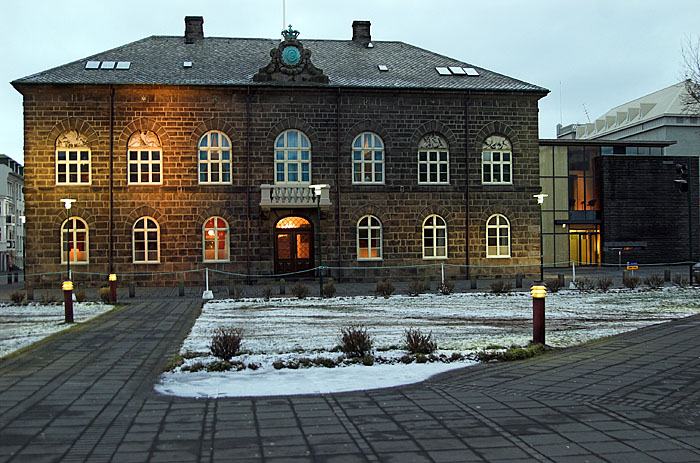
 Althing, the Icelandic parliament is now developing an Arctic policy for the Icelandic government. The work is being conducted under the management of the Icelandic foreign minister Össur Skarphéðinsson. Icelandic authorities are becoming aware of the state’s significant status within the Arctic and regional cooperation and have thus decided that a declared policy is needed for the Icelandic state to have impact on future developments in the area. The main aim of the policy is to secure Icelandic interests within the region and strengthen relations with other Arctic states and various stakeholders.
One significant political aspect can be found in the proposed policy, namely to make sure Iceland is considered to be an Arctic coastal state. This is thought to be important in order to reverse the recent development of the Arctic five meetings. Icelandic authorities do not welcome any deliberate undermining of the Arctic Council as the forum for regional cooperation on Arctic matters and would rather want the Council to be strengthened. In addition to this political view, the Icelandic government wants international obligations and agreements to be observed in decision-making and settlements of disputes.
In discussions on the proposed Arctic policy in the Althing, some concerns have been raised regarding the Arctic five meetings and there does seem to be a general view within the parliament that this development should be obstructed as possible. However, the clear will of the Icelandic government to secure the state’s spot as an Arctic coastal state seems to imply that such “Arctic six” meetings could be more welcomed with Iceland on board. In reality, this deliberation is rather improbable as the Icelandic government is keen on prevent the exile of small state actors such as the Faroe Islands and the non-Arctic coastal states within the Arctic Council, Finland and Sweden.
 Another significant aspect of the proposed Icelandic Arctic policy is react against armament in the Arctic region has been raised in the parliament. This point has been discussed to a certain degree in the Althing, where the foreign minister has tried to water down the concerns of direct military confrontation or severe armament. The third significant political aspect of the discussions in the Althing about the policy is the EU negotiation phase and the outcome in Arctic matters for the European Union. Some concerns have been raised that the argument for Iceland as an Arctic coastal state is meant to secure the interests of the EU instead those of Iceland specifically. Even though this concern might be a bit farfetched, it was officially declared by the EU that Arctic matters were the primary gain for the EU with the membership of Iceland.
The Icelandic Arctic policy will consist of eleven general elements that together represent the main concerns of Icelandic authorities, in addition to interests that will be pursued. There are no big surprises in the proposed policy, with the development of Iceland’s status as an Arctic costal state as the exception. The focus of Icelandic government on the rights of indigenous peoples and other inhabitants of the Arctic is, however, also a significant attribute that could be seen as unusual.
The eleven elements of the proposed Arctic policy of the Icelandic government are as follows:
- Secure the status of Iceland as an Arctic coastal state regarding decisions on Arctic issues. This will be based on the geographical, economic and ecological reasons.
- Increase global understanding on that the Arctic region is not restricted to the area north of the Arctic Circle, but other areas based on various ecological, economic and geopolitical reasons.
- Strengthen the Arctic Council as the main cooperative body on Arctic issues and press for decisions to be made within the Council.
- Build on the United Nations Convention on the Law of the Sea which sets out the universal principles of marine governance.
- Strengthen and increase cooperation with the Faroe Islands and Greenland with the aim of increasing the economic and political status of the three states.
- Secure and support the rights of indigenous peoples in the Arctic and secure their involvement in decision making.
- Build on international agreements and encourage cooperation with other states and stakeholders on Arctic issues regarding Icelandic interests in the Arctic.
- Safeguard civil security interest in the Arctic and react against armament in the area. Increase cooperation with other states on preservation of wildlife, research, and preparedness in surveillance, search and rescue and pollution prevention in order to secure environmental, communal and sustainable development interests.
- Develop commercial cooperation between Arctic states and secure Icelandic opportunities in economic development within the region.
- Increase national knowledge on Arctic issues and introduce Iceland as a forum for conferences, meetings and discussions on Arctic issues. Effort shall be made to establish centers, research institutes and educational institutions on Arctic affairs in cooperation with other states and international institutions.
- Increase national consultation and cooperation on Arctic issues to secure increased knowledge on the status of the Arctic, democratic dialogue and solidarity on the implementation of the official Arctic policy. The foreign minister shall develop and implement the Arctic policy in consultation with the Althing’s committees on foreign affairs and environment.
No major changes are expected to be made on the eleven elements mentioned above. A few might, however, become more precise in order to make implementation easier. The implementation of the policy and the making of an Arctic strategy will be initiated after the proposed Arctic Policy has been developed. The proposed Arctic strategy will most likely be finalized in early summer of 2011.
- Details
- Written by: ofurpaur
- Category: YAR & Features
- Hits: 7116
 Recognizing that the circumpolar Arctic region is experiencing significant ecological change due to global climate change, the Aspen Institute convened a civil society Dialogue and Commission to consider the implications of this impending transformation for the region's inhabitants and resources. The Aspen Institute released a final report and recommendations of Commission, entitled "The Shared Future: A Report of the Aspen Institute Commission on Arctic Climate Change."
The report features a very special foreword by President Jimmy Carter and presents the Commission's recommendations, foremost of which is that governance in the Arctic marine environment should be sustained and strengthened by a new conservation and sustainable development plan based on using an ecosystem-based management approach.
The Commission believes marine spatial planning provides a workable method to begin implementation of ecosystem-based management. Governance of the Arctic can and should be strengthened through an inclusive and cooperative international approach that allows greater participation in information gathering and sharing, and decision-making, leading to better information policy choices and outcomes.
The report is issued under the auspices of the Aspen Institute and the members of the Aspen Institute Commission on Arctic Climate Change, with support from the Prince Albert II of Monaco Foundation.
Aspen Climate Change Report - Handout
 The report presents the Commission's recommendations, foremost of which is that governance in the Arctic marine environment, which is determined by domestic and international laws and agreements, including the Law of the Sea, should be sustained and strengthen by a new conservation and sustainable development plan using an ecosystem-based management approach. The Commission believes marine spatial planning provides a workable method or approach to begin implementation of ecosystem-based management. According to the Commission, Arctic governance can and should be strengthened through an inclusive and cooperative international approach that allows greater participation in information gathering and sharing, and decision-making, leading to better informed policy choices and outcomes.
 The Commission recognizes that this Aspen Dialogue has been a preliminary step toward a fuller discussion on the future of the Arctic marine environment. Its major discovery is that a more modern, holistic and integrating international plan is needed to sustainably steward and govern the Arctic marine environment. The Commission has made significant progress in understanding the needs and requirements for action to sustain the Arctic and realizes that in order to implement its recommendations the entire Arctic community must be engaged.
The Aspen Commission on Arctic Climate Change has identified the following initial Principles of Arctic Governance as forming the guiding foundation of its recommendations and the standards by which future governance and sustainable management of human activities in the Arctic marine environment should be measured. Specifically, governance and sustainable management of human activities in the Arctic marine environment should seek to:
- Optimize ecosystem resilience, integrity and productivity by maintaining food-web (trophic) structure and protecting and restoring biodiversity and available habitat.
- Maintain the full suite of Arctic ecosystem services to support human well-being on a continuing basis.
- Promote investment in scientific research and related infrastructure necessary to ensure sustainable development and environmental protection.
- Avoid exacerbating changes that may be difficult or impossible to reverse in temperature, sea-ice extent, pH, and other key physical, chemical and biological ecosystem parameters.
- Assess, monitor and manage multiple human activities using an integrated, adaptive, ecosystem-based management system that takes into account risks and cumulative and interacting effects.
- Apply ecosystem-based management processes based on science and traditional knowledge, particularly to new and expanded human activities which are subject to prior evaluation and analysis. Prudent measures to reduce or eliminate impacts are to be taken when there are reasonable grounds for concern that such activities, directly or indirectly, will bring about hazards to human health, harm living resources and ecosystems, damage amenities or interfere with other legitimate uses.
- Fully respect the rights, including human rights, of Arctic residents and Arctic indigenous peoples, and maximize participation in and transparency of decision-making for all interested stakeholders.
- Link global policy discussions to the need to conserve and manage Arctic ecosystems and dependent communities.
- Promote cooperation among Arctic states to arrive at appropriate standards for managing activities in the Arctic to meet the special conditions of the Arctic region, while promoting sustainable development.
- Inform, in a timely manner, national and international decision-makers as well as the public of the consequences of climate change impacts in the Arctic, and needed actions required to meet the above noted principles.
 The Aspen Institute Commission on Arctic Climate Change believes that existing frameworks can be enhanced and new frameworks can be established to improve governance and strengthen resilience in the Arctic marine environment in response to climate change impacts and the need for adaptation readiness. The Commission developed its recommendations against the backdrop of at least three observable strategies currently discussed internationally to strengthen the Arctic Council; expand and strengthen the existing system of bilateral and multilateral agreements; and/or establish a new Framework Convention for Arctic governance.
Aspen Commission Recommendations
- Arctic governments should take immediate steps to begin developing an Arctic Marine Conservation and Sustainable Development Plan by 2012, in collaboration with civil society and other interested parties.
- Arctic governments, independently and collectively, should implement an integrated ecosystem-based management approach in the Arctic marine environment utilizing appropriate marine spatial planning, as well as regulatory rules and standards that address the special conditions of the Arctic region.
- In addition to an Arctic marine conservation and sustainable development plan, a number of specific actions should be initiated through the development of agreements or standards that foster consistent implementation among and across Arctic governments.
- An open-source Arctic network, focused on ecosystem-based management, should be developed through the Arctic Council and used to complement the existing system of national and international governance mechanisms in the Arctic.
- Arctic governments should call for a special diplomatic conference in 2012, which includes participation by Indigenous Peoples and the eight Arctic nations, to establish a timetable for designing and implementing the preceding recommendations.
- All Arctic residents, including Indigenous Peoples, should play a pivotal role in planning the future of the Arctic and should share in the benefits of its resources as well as responsibility for its sustainable future.
- An Arctic science program should be implemented and integrated as part of the Arctic Marine Conservation and Sustainable Development Plan using an open-source information network.
- The Commission urges that the Arctic Council be reinforced as an effective, multilateral organization for the region and that it be given the resources and a revised architecture to ensure that the planning, participation, management and accountability recommendations put forward in this report are implemented.
About the Aspen Institute
The Aspen Institute mission is twofold: to foster values-based leadership, encouraging individuals to reflect on the ideals and ideas that define a good society, and to provide a neutral and balanced venue for discussing and acting on critical issues.
The Institute is based in Washington, DC, Aspen, Colorado, and on the Wye River on Maryland's Eastern Shore and has an international network of partners. Further information.